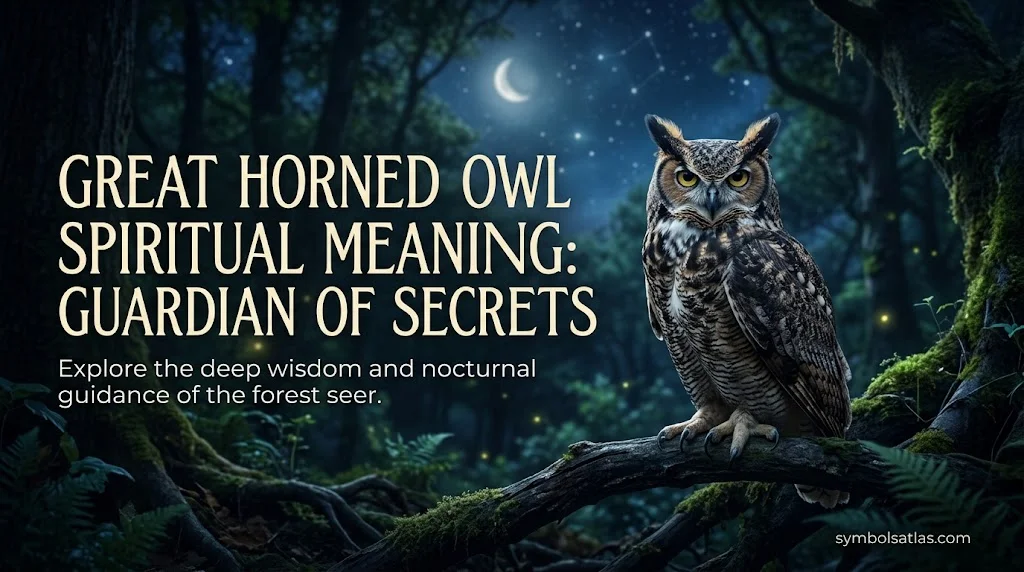

The Great Horned Owl spiritual meaning is often linked to wisdom, intuition, protection, and hidden truths.
Seeing a Great Horned Owl can feel like a powerful and meaningful encounter. Across spiritual traditions, this remarkable bird is often associated with wisdom, intuition, mystery, protection, and transformation. Its ability to move silently through the night gives it a strong connection with the unknown and unseen. For some people, encountering this owl may symbolize a need to trust their inner voice or pay closer attention to signs around them. Its distinctive horns and powerful presence can also represent strength, courage, independence, and spiritual awareness. However, the meaning can vary depending on the situation, personal beliefs, and emotions you experience during the encounter. Understanding the spiritual symbolism of the Great Horned Owl can help you reflect on what this mysterious bird may represent in your own life.
The Great Horned Owl carries rich symbolism because it combines strength, mystery, and remarkable nighttime awareness. Spiritually, it may represent deep wisdom, the ability to see beyond appearances, and the courage to face things hidden from ordinary sight. An owl appearing repeatedly may encourage you to trust your intuition and listen carefully to your inner guidance. In some interpretations, it can symbolize protection, especially during periods of uncertainty or personal change. The owl may also represent transformation, reminding you that endings can create space for new beginnings. Its silent flight can symbolize quiet observation, patience, and thoughtful decision-making. Whether you see the Great Horned Owl in nature, dreams, artwork, or repeated signs, its appearance can invite deeper reflection. Rather than having one universal meaning, its symbolism often depends on your circumstances and personal spiritual perspective.
Quick Answer
Great Horned Owl Spiritual Meaning: Guardian of Secrets often symbolizes intuition, protection, hidden knowledge, strength, and awareness in modern American spiritual interpretations. Its meaning can also reflect mystery, transition, and the ability to see beyond what appears obvious.
TL;DR
- Great Horned Owls symbolize awareness, mystery, strength, and hidden knowledge.
- Their nighttime habits encourage associations with intuition and unseen truths.
- American traditions contain both positive and cautionary owl interpretations.
- Ancient Greek wisdom symbolism belongs to a different owl species.
- Modern encounters often become personal symbols of observation and inner guidance.
- Meanings vary by culture, context, and individual experience.
Great Horned Owl Symbolism at a Glance
The Great Horned Owl has a striking appearance that naturally invites symbolism. Its feather tufts resemble horns, while its bright eyes create an intense, watchful expression.
For American readers, the bird can symbolize the ability to remain alert when circumstances feel uncertain. It can also represent quiet confidence rather than loud displays of power.
Core Symbolic Themes
Several meanings commonly appear in modern interpretations:
• Intuition — noticing details that others overlook
• Protection — watching carefully over people, places, or boundaries
• Mystery — exploring what remains hidden or unexplained
• Wisdom — learning through observation and experience
• Strength — remaining capable during difficult conditions
• Transformation — moving through uncertainty toward greater awareness
These meanings aren’t universal rules. Instead, they provide a symbolic framework people may use when reflecting on an owl encounter.
What Does a Great Horned Owl Represent?
The Great Horned Owl represents different ideas depending on the setting. Its physical traits are important because symbolism often develops from what people observe in nature.
Seeing What Others Miss
Great Horned Owls have excellent night vision and highly sensitive hearing. Their ability to hunt in darkness makes them a natural metaphor for perception.
Therefore, seeing one may inspire the thought, “Look more closely.” Symbolically, it can encourage patience before making a judgment.
A Guardian of Boundaries
The Great Horned Owl protects its territory and can defend its nest. This behavior can inspire symbolic associations with boundaries and vigilance.
For someone facing uncertainty, the owl may represent staying aware without becoming fearful. Its presence can serve as a reminder to protect personal space and values.
What Does a Great Horned Owl Look Like?
Understanding the bird itself makes its symbolism easier to appreciate. The Great Horned Owl is one of North America’s most recognizable owls.
Physical Features and Symbolic Associations
It has prominent feather tufts, a large head, yellow eyes, a broad body, and strongly patterned feathers. Its coloring usually blends shades of brown, gray, black, and white.
Its features can carry different symbolic impressions:
| Feature | Meaning in the USA | Common Association | Symbolic Note |
| Yellow eyes | Awareness | Focus and perception | Seeing clearly |
| Feather tufts | Strength | Authority and presence | Standing confidently |
| Silent flight | Mystery | Privacy and subtle action | Moving quietly |
| Night activity | Unknown | Intuition and reflection | Exploring uncertainty |
| Powerful talons | Protection | Strength and defense | Holding firm |
| Deep hoot | Presence | Warning and communication | Paying attention |
The symbolism comes from observation rather than proof of a supernatural message. Nature provides the imagery, while people create personal meaning around it.
Historical Roots of Great Horned Owl Symbolism
Owl symbolism is much older than modern spiritual trends. However, not every ancient owl tradition refers specifically to the Great Horned Owl.
Ancient and Pre-Christian Connections
In ancient Greece, the owl became strongly associated with Athena, a goddess connected with wisdom and strategic thought. The famous owl appearing on Athenian coins was the Little Owl, not the Great Horned Owl.
That distinction matters. The Great Horned Owl is native to the Americas, so directly transferring ancient Mediterranean symbolism to this species can create historical confusion.
Still, the broader owl image later became connected with wisdom in Western culture. Books, schools, artwork, and popular stories helped strengthen that association.
From Nature to Archetype
Across different societies, nighttime animals often became associated with mystery. People noticed that owls could move quietly, see in darkness, and appear suddenly.
As a result, owls developed a dual symbolic identity. They could represent wisdom and insight, but they could also symbolize uncertainty, death, or the unknown.
Great Horned Owl Symbolism in the USA
The Great Horned Owl has a particularly strong place in American nature and culture. It is widespread across the continent and can adapt to many environments.
A Familiar American Wild Bird
The bird appears in forests, agricultural areas, wetlands, deserts, parks, and suburban spaces. Its ability to live near people makes an encounter feel surprisingly personal.
At the same time, its nighttime lifestyle preserves a sense of mystery. You may hear the owl long before you see it.
Strength and Independence
American culture often connects wildlife with independence and resilience. The Great Horned Owl fits that image because it is a capable predator that survives across diverse habitats.
Its symbolism can therefore suggest:
• Independence without unnecessary attention
• Confidence during uncertain situations
• Protection of personal boundaries
• Adaptability across changing environments
• Quiet strength instead of dramatic displays
The bird’s presence can feel especially meaningful when someone is entering a new stage of life.
Native American Meanings of the Great Horned Owl
There is no single Native American meaning for the Great Horned Owl. Indigenous nations have distinct histories, languages, ceremonies, and beliefs.
Why One Meaning Doesn’t Fit Every Nation
Some documented traditions have treated certain owls as powerful or protective. Others have connected owls with death, spirits, warnings, or supernatural danger.
For example, Lakota cultural sources describe Great Horned and Screech Owls as having powerful and sometimes dangerous associations. Other Indigenous traditions have given owls very different roles.
Therefore, saying that “Native Americans believe owls mean wisdom” oversimplifies many separate cultures. A respectful approach recognizes differences rather than combining them into one belief system.
Learning From the Diversity
This diversity is important for modern readers. It shows that symbolism develops from specific relationships between people, landscapes, animals, and traditions.
It also explains why an owl can represent protection in one context and a warning in another. Both meanings can exist without one tradition being treated as the universal answer.
Cross-Cultural and Spiritual Meanings
Owl symbolism appears in many parts of the world, but its meanings aren’t identical. The Great Horned Owl itself is most relevant to the Americas.
Wisdom in Western Tradition
The connection between owls and wisdom became especially strong through ancient Greek imagery. Athena’s owl became a lasting symbol of knowledge and careful thought.
However, modern people often apply this broad owl symbolism to many owl species. That practice is understandable, but it isn’t the same as saying every owl historically represented wisdom.
Mystery and the Spirit World
In several cultural traditions, nighttime birds became connected with the unseen world. Their calls could seem mysterious because people heard them without seeing their source.
For spiritual readers today, this can translate into ideas about hidden knowledge, intuition, and reflection. However, those modern interpretations shouldn’t be presented as universal religious truths.
Read More: Rooster Crowing at Night Spiritual Meaning: Unexpected
Spiritual Meaning of Seeing a Great Horned Owl
A Great Horned Owl encounter can feel powerful because the bird is large, quiet, and often difficult to spot.
If You See One During the Day
A daytime sighting doesn’t automatically carry a spiritual message. Great Horned Owls can sometimes be active during daylight, especially around dawn, dusk, nesting areas, or when responding to disturbances.
Symbolically, however, people may interpret an unexpected daytime appearance as a reminder to become more observant.
If You Hear One at Night
Hearing an owl without seeing it can create a stronger feeling of mystery. The sound arrives from darkness, while the bird itself may remain hidden.
As a personal symbol, this experience may encourage you to listen carefully before acting. It can represent information that isn’t immediately visible.
If an Owl Appears Repeatedly
Repeated encounters may feel meaningful, especially when they happen during an important period. Still, repetition doesn’t prove that the bird is delivering a supernatural message.
Instead, consider what the owl represents to you. Your own circumstances can provide more useful meaning than a fixed interpretation.
Emotional and Psychological Meaning
Symbols often become powerful because they help people describe feelings. The Great Horned Owl can represent emotional qualities that many people value.
The Psychology of the Watchful Owl
The owl’s fixed gaze can suggest attention and self-awareness. Its quiet behavior can also represent thoughtful observation.
For some people, the owl reflects a desire to understand before responding. That makes it a useful symbol during periods of uncertainty.
Common Emotional Associations
People may associate the Great Horned Owl with:
• Calm observation during stressful situations
• Confidence without the need for attention
• Curiosity about hidden information
• Emotional independence and self-trust
• Patience before making important choices
• Courage when facing uncertainty
These are symbolic associations, not psychological diagnoses or guaranteed effects.
Great Horned Owl Spiritual Meaning in Modern Life
Modern spirituality often treats animal encounters as opportunities for reflection. Social media has also made symbolic interpretations easier to share.
Social Media and Personal Meaning
A photograph of a Great Horned Owl can represent mystery, confidence, nature, or personal transformation. Captions often use the bird to express ideas about intuition and inner strength.
However, online interpretations can become simplified. A single image may receive dozens of different meanings depending on the creator.
Home Decor and Art
Owl artwork appears in paintings, sculptures, posters, textiles, and nature-inspired decor. Great Horned Owl imagery can create a feeling of wilderness and quiet mystery.
In American homes, owl designs may also represent a love of wildlife. They don’t necessarily indicate spiritual beliefs.
Great Horned Owl Tattoos and Identity
Animal tattoos often carry personal meanings rather than one fixed definition. A Great Horned Owl tattoo can symbolize a person’s connection with nature, independence, or self-awareness.
Common Tattoo Meanings
People may choose owl imagery to represent:
• Wisdom gained through difficult experiences
• Protection of loved ones and personal values
• Curiosity about life’s unanswered questions
• Strength during a major transition
• Connection with nighttime, nature, or solitude
• Respect for a powerful North American bird
The meaning can also depend on design choices. A moon, forest, stars, feathers, or mountains can change the emotional tone.
Misunderstandings and Controversies
Great Horned Owl symbolism can become confusing when different traditions are blended.
The “Owl Always Means Wisdom” Myth
The wisdom association is real within certain Western traditions. Yet it doesn’t describe every culture or every owl species.
The Great Horned Owl has its own ecological and cultural history. Its symbolism shouldn’t be reduced to the familiar “wise owl” image.
The “Owl Always Means Death” Myth
The opposite mistake is treating every owl encounter as a bad omen. Some Indigenous traditions have connected certain owls with death or danger, but those beliefs aren’t universal.
A Great Horned Owl flying near a home isn’t evidence that something bad will happen. Natural behavior should be considered first.
Respecting Indigenous Traditions
Modern spiritual writing sometimes combines teachings from unrelated Indigenous nations. This can erase important differences.
A respectful interpretation identifies traditions carefully. It also avoids presenting sacred or community-specific beliefs as simple spiritual facts for everyone.
How Great Horned Owl Meanings Have Changed
The symbolism surrounding owls has never been completely fixed. It has changed as societies changed their relationships with nature.
From Fear to Fascination
Historically, nighttime animals could inspire fear because darkness limited human vision. An unseen owl call could feel mysterious or threatening.
Today, many Americans encounter owls through birdwatching, wildlife photography, conservation programs, parks, and nature education. This has encouraged greater appreciation alongside older folklore.
From Folklore to Personal Symbolism
Modern spiritual culture often turns animal encounters into personal reflection. Instead of asking only what an owl “means,” people may ask what it represents in their current life.
That shift makes symbolism more personal. The owl becomes a prompt for reflection rather than a fixed prediction.
What the Great Horned Owl Can Teach Symbolically
The strongest modern interpretation of this bird focuses on observation. Its behavior encourages people to slow down and notice what they might otherwise miss.
Lessons From Its Natural Behavior
The owl can inspire several reflective ideas:
• Observe before reacting to unfamiliar situations
• Protect your boundaries without creating unnecessary conflict
• Trust careful attention over quick assumptions
• Stay adaptable when circumstances change
• Accept that some answers require patience
• Recognize strength that doesn’t need constant display
These lessons don’t require a supernatural belief. They can simply emerge from appreciating the animal.
FAQs
What is the spiritual meaning of a Great Horned Owl?
The Great Horned Owl spiritual meaning is commonly associated with wisdom, intuition, protection, mystery, and transformation. Its appearance may encourage you to trust your instincts and look beyond what seems obvious.
Is seeing a Great Horned Owl a good spiritual sign?
For many spiritual interpretations, seeing a Great Horned Owl can be viewed as a meaningful sign. It may symbolize guidance, awareness, inner strength, or protection, especially during periods of change.
What does a Great Horned Owl symbolize in dreams?
A Great Horned Owl in a dream may represent hidden knowledge, intuition, wisdom, or spiritual awareness. The meaning can depend on the owl’s behavior and the emotions you experienced during the dream.
What does it mean when a Great Horned Owl appears repeatedly?
Repeated encounters may encourage you to pay closer attention to your inner voice and surroundings. Spiritually, some people interpret this pattern as a reminder to observe and trust their personal intuition.
Does a Great Horned Owl represent protection?
Yes. In some spiritual traditions and modern interpretations, the owl represents protection and watchfulness because of its exceptional nighttime vision. Its symbolism can suggest staying alert while navigating uncertainty or personal transformation.
Conclusion
The Great Horned Owl spiritual meaning can offer a powerful symbol of wisdom, intuition, protection, courage, and transformation. Its mysterious nighttime presence often encourages deeper observation and greater trust in your inner guidance. Whether you encounter one in nature, see it in a dream, or notice it repeatedly, the experience can inspire meaningful personal reflection.
Ultimately, there isn’t one fixed meaning behind seeing a Great Horned Owl. Your circumstances, emotions, beliefs, and the details of the encounter all matter. Consider what was happening in your life when the owl appeared, and use its symbolism as an opportunity to explore self-awareness, spiritual growth, and hidden truths.