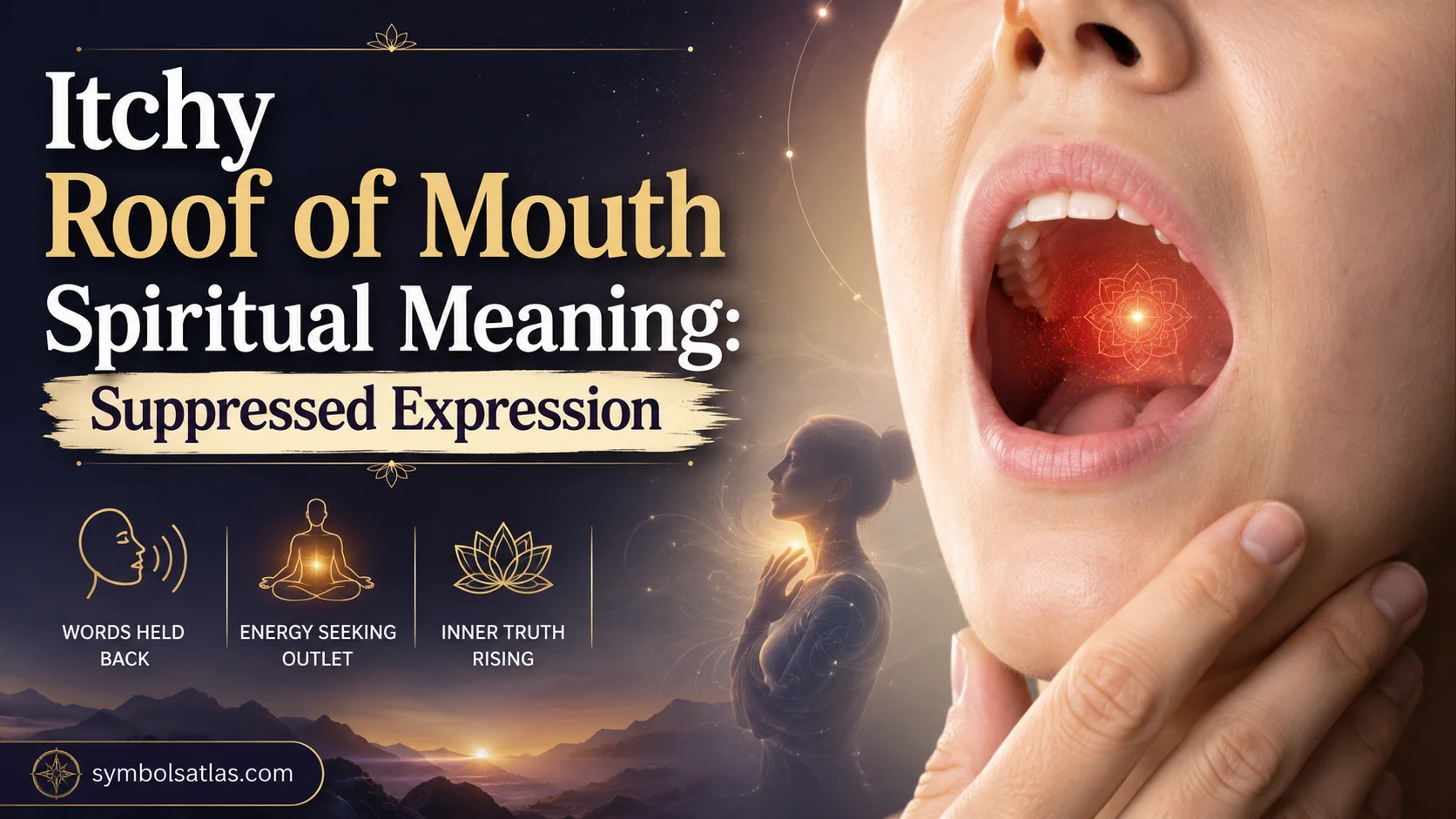

The Itchy Roof of Mouth Spiritual Meaning may connect a bodily sensation with spiritual symbolism, inner thoughts, communication, and intuition.
An itchy roof of the mouth can be seen as a gentle reminder to notice suppressed feelings, thinking, feeling, holding back, or a desire to express something unsaid. In different spiritual traditions, spiritual seekers may connect this phenomenon with spiritual awakening, divine communication, an inner voice, the inner self, and a deeper connection with the universe. These symbolic meanings can have multiple interpretations involving energy symbolism, mindfulness, spirituality, and personal growth, but they remain a belief rather than a proven explanation for a physical sensation. A physical cause should also be considered.
Patient 1 had itching on the roof of the mouth, while a doctor was unsure about the condition, and Patient 2 suggested oral allergy syndrome, or OAS, also called mouth and throat allergy syndrome. Unlike angio-oedema, a severe allergy reaction involving swelling of the lips and tongue, OAS can cause itching of the roof of the mouth without swelling of the tongue and lips and belongs to a spectrum of less life-threatening conditions. Allergy, symptoms, and reaction remain important physical considerations, and colleagues have noted that OAS is not uncommon. The oral, mouth, and throat can therefore have both.
Quick Answer
Itchy roof of mouth spiritual meaning is commonly interpreted in the USA as a symbol of suppressed expression, unspoken feelings, communication, or a need to speak honestly. In broader spiritual traditions, it may also represent intuition, inner awareness, or emotional release.
TL;DR
- An itchy palate can symbolize words or feelings that remain unspoken.
- Modern spiritual interpretations often connect it with communication and self-expression.
- The mouth traditionally represents speech, nourishment, and connection.
- Some spiritual practices associate mouth sensations with energetic awareness.
- Meanings vary widely across cultures and personal belief systems.
- A physical itch can also have ordinary causes unrelated to spirituality.
What Does an Itchy Roof of the Mouth Symbolize?
The roof of the mouth has an interesting symbolic position. It sits inside the mouth, a place closely linked with speech, taste, nourishment, and connection. Therefore, spiritual interpretations often focus on what enters the body and what leaves it.
For a USA reader, the most useful approach is to treat the symbolism as reflective rather than predictive. Instead of assuming the itch guarantees an event, consider what the sensation might remind you to examine.
Suppressed Expression
The strongest modern interpretation involves something you want to say but haven’t said.
You might be avoiding a difficult conversation, hiding an opinion, or minimizing your emotions. Symbolically, the itch becomes a metaphor for an inner message asking for attention.
A Desire to Be Heard
The sensation may also represent a wish to feel understood.
This interpretation can apply when you feel ignored, misunderstood, or unable to communicate openly. The symbolic lesson becomes simple: your thoughts deserve acknowledgment, even if you choose carefully when to share them.
Inner Truth
Another interpretation involves personal honesty.
An itchy palate may symbolically encourage you to ask whether your words match your real feelings. Sometimes, the issue isn’t speaking more. Instead, it’s becoming more truthful with yourself.
Spiritual Meaning of an Itchy Roof of Mouth
Spiritual interpretations often connect the mouth with expression and personal truth. However, there isn’t one universal spiritual meaning assigned to this sensation.
Instead, modern interpretations tend to vary according to personal beliefs, spiritual practices, and cultural background.
Communication and Expression
The mouth naturally represents communication because it produces spoken words. Consequently, an unusual sensation there can become a symbol of communication that feels blocked.
This interpretation may resonate when you’ve been keeping something important inside.
Spiritual Awareness
Some people view unusual bodily sensations as invitations to become more mindful. The sensation itself doesn’t have to predict anything.
Instead, it can encourage you to pause and notice your thoughts, emotions, and surroundings.
Emotional Release
An itch can also symbolize the desire to release something uncomfortable.
That “something” might be resentment, fear, sadness, frustration, or even an unspoken dream. Symbolically, releasing the feeling creates room for greater emotional clarity.
What Does Suppressed Expression Mean Spiritually?
Suppressed expression means holding back thoughts, emotions, needs, or personal truths. In spiritual symbolism, this can represent a disconnect between your inner experience and outward behavior.
The mouth becomes an especially strong symbol because speech turns private thoughts into shared experiences.
When You’re Holding Something Back
An itchy roof of the mouth may feel especially meaningful when it happens during emotional tension.
For example, you might notice it while thinking about:
- A conversation you keep postponing
- Feelings you haven’t shared with someone
- A boundary you need to communicate
- An opinion you’re afraid to express
- A personal truth you’ve been avoiding
The symbolism doesn’t prove that your body caused the sensation because of those feelings. Instead, the connection can serve as a useful prompt for reflection.
Speaking Without Overreacting
Speaking your truth doesn’t mean saying everything immediately.
Healthy expression can involve timing, kindness, and thoughtful boundaries. Sometimes the spiritual lesson is not “speak louder,” but “speak more honestly.”
Read More: Spiritual Meaning of Koi Fish: Prosperity & Perseverance
The Mouth as a Symbol of Communication
Across many symbolic systems, the mouth has represented communication, nourishment, desire, and social connection.
This makes intuitive sense. The mouth allows people to share stories, promises, prayers, songs, opinions, and affection.
Words as Personal Power
Words can influence relationships and communities. They can comfort someone, create conflict, preserve history, or communicate identity.
Because of this, spiritual symbolism often treats speech as something deserving care.
An itchy mouth can therefore become a metaphor for becoming more conscious of your words.
The Balance Between Speaking and Listening
Communication isn’t only about talking.
Listening can be equally important. In some situations, the symbolic message may be to pause before speaking and understand what someone else is saying.
That creates a more balanced interpretation than simply assuming every sensation means “you need to talk.”
Historical Roots of Mouth Symbolism
The specific idea that an itchy roof of the mouth has a spiritual meaning does not have a well-established ancient history.
Modern websites sometimes describe the sensation as an ancient omen, but strong evidence for a single, widespread ancient tradition is limited. It’s more accurate to separate documented symbolism of the mouth from modern interpretations of palate itching.
Ancient Symbolism of the Mouth
In many ancient societies, the mouth carried important symbolic meanings because speech had social and sacred power.
People used spoken words for:
- Prayers and ritual speech
- Oaths and promises
- Storytelling and oral history
- Blessings and formal declarations
- Songs and communal traditions
Therefore, the mouth naturally became associated with truth, authority, connection, and sacred communication.
From Ancient Symbolism to Modern Spirituality
Modern spiritual interpretations often combine older symbolic ideas with contemporary concepts.
For example, traditional ideas about sacred speech may blend with modern discussions of intuition, energy, mindfulness, and emotional healing. This creates new interpretations that may feel ancient but are sometimes relatively recent.
Recognizing that difference makes the symbolism more historically honest.
Itchy Roof of Mouth Meaning in American Culture
In the United States, bodily signs are interpreted through many different cultural lenses. Folk beliefs, religious traditions, wellness practices, psychology, and social media can all influence how people understand unusual sensations.
As a result, there isn’t one American interpretation.
Modern American Spirituality
Contemporary American spirituality often emphasizes personal meaning.
A person may interpret an itchy palate as a reminder to:
- Trust personal intuition
- Express feelings honestly
- Examine emotional tension
- Practice mindfulness
- Pay attention to inner thoughts
- Become more authentic
These ideas fit the broader American interest in personal growth and self-discovery.
Folk Beliefs and Personal Signs
American culture also has a long history of interpreting everyday events symbolically.
People may attach meaning to dreams, repeated numbers, animal encounters, unusual coincidences, or bodily sensations. However, these meanings often differ between families and communities.
That makes personal interpretation important.
Itchy Roof of Mouth and the Throat Chakra
The throat chakra is frequently mentioned in modern spiritual discussions about mouth and communication.
In contemporary chakra-based practices, the throat chakra is commonly associated with communication, truth, listening, and self-expression.
Communication and the Throat Chakra
Because the mouth and throat work together during speech, an itchy palate may be symbolically connected with this energy center.
Some people interpret the sensation as a sign of blocked expression. Others see it as encouragement to communicate more clearly.
These interpretations belong to modern spiritual practice rather than established medical science.
Finding Your Voice
Symbolically, finding your voice means becoming comfortable expressing your authentic perspective.
That doesn’t require confrontation. Instead, it may involve saying what you need, setting a boundary, asking for help, or admitting how you feel.
Emotional and Psychological Meaning
Physical sensations can become meaningful when they occur during emotionally important moments. From a symbolic perspective, an itchy mouth can represent inner tension around communication.
The interpretation becomes especially interesting when you notice a pattern between the sensation and your emotional state.
Common Emotional Associations
People may connect this symbolism with feelings such as:
- Frustration from not being understood
- Anxiety about an upcoming conversation
- Fear of rejection or criticism
- Relief after finally expressing emotions
- Curiosity about an emerging personal truth
- Desire for greater emotional freedom
These associations don’t establish a cause-and-effect relationship. Instead, they offer questions for self-reflection.
A Useful Reflection
When the sensation occurs, ask yourself:
“What am I trying not to say?”
Then consider a second question:
“Would saying it actually help?”
Those questions can separate genuine communication needs from temporary emotional reactions.
Itchy Roof of Mouth Spiritual Meaning in Different Contexts
The same sensation can take on different symbolic meanings depending on what’s happening in your life.
Context often matters more than the sensation itself.
| Context | Possible Symbolic Meaning | Common Association | Helpful Reflection |
| Before a difficult conversation | Need for honest expression | Communication | What needs to be said? |
| During emotional stress | Inner tension | Suppressed feelings | What am I avoiding? |
| During meditation | Increased awareness | Intuition | What am I noticing? |
| During major life changes | Desire for clarity | Personal growth | What truth is emerging? |
| During social conflict | Need for boundaries | Self-expression | What do I need to communicate? |
These meanings are interpretive rather than universal rules. Your personal circumstances can change how the symbolism feels.
Cross-Cultural and Spiritual Interpretations
Physical sensations have been interpreted symbolically in many cultures. However, it’s important not to claim that every tradition assigns the same meaning to an itchy palate.
Different systems have different ideas about the relationship between body, emotion, and spirit.
Energy-Based Interpretations
Some modern holistic traditions view unusual sensations as signs of energetic shifts.
Within those frameworks, an itchy mouth may be connected with communication or emotional balance. The exact meaning depends on the specific tradition.
Intuition and Inner Messages
Some spiritual practitioners view bodily sensations as prompts for intuitive awareness.
In that approach, the sensation isn’t necessarily a supernatural message. Instead, it becomes a cue to slow down and notice what your mind and emotions are already communicating.
Respecting Cultural Differences
Symbolic meanings should always be considered within their proper context.
A belief found in one modern spiritual community shouldn’t automatically be described as an ancient belief shared by an entire culture. Careful language helps preserve both accuracy and respect.
Modern Uses in Tattoos, Social Media, and Personal Identity
The idea of expressing what remains hidden fits naturally into modern visual culture.
Although an itchy palate itself isn’t a common tattoo symbol, related imagery can represent the same theme.
Common Symbolic Imagery
People interested in self-expression may use:
- Lips representing speech and personal identity
- Open mouths representing freedom of expression
- Throats representing voice and authenticity
- Written words representing hidden thoughts
- Broken chains representing emotional release
- Speech bubbles representing communication
These images can communicate personal stories without explaining every detail.
Social Media and Digital Expression
Social platforms have also changed how people think about having a voice.
People now share opinions, personal stories, identities, creative work, and emotional experiences publicly. Because of that, communication symbolism often overlaps with themes of authenticity and visibility.
An itchy-mouth interpretation can therefore feel relevant to someone navigating how openly they communicate online.
Is an Itchy Roof of Mouth a Good or Bad Sign?
There’s no universal spiritual rule saying that an itchy palate is either good or bad.
Some spiritual interpretations describe it as a warning about emotional imbalance. Others view it as a positive invitation toward growth, honesty, and awareness.
Positive Interpretation
A positive reading might suggest that you’re becoming more aware of something important.
The itch can symbolically represent an opportunity to acknowledge your feelings and communicate with greater confidence.
Cautionary Interpretation
A more cautious interpretation might encourage you to think before speaking.
Words can affect relationships. Therefore, the symbolic message could involve using your voice wisely rather than simply speaking whatever comes to mind.
Common Misunderstandings and Misuse
Online spiritual content can sometimes present symbolic interpretations as universal facts.
That can make a personal belief sound like a documented historical rule.
Symbolism Is Not Proof
An itchy palate doesn’t prove that someone is thinking about you, that a supernatural message is arriving, or that a specific event will happen.
Those claims belong to personal spiritual belief.
Don’t Ignore Ordinary Explanations
There are also ordinary reasons for an itchy roof of the mouth. Allergies, irritation, infections, dry mouth, and reactions to certain foods can cause mouth or palate itching.
Therefore, spiritual reflection shouldn’t replace sensible attention to persistent physical symptoms.
If the sensation is severe, recurring, or accompanied by swelling or breathing difficulty, professional medical attention is important.
How the Meaning Has Changed Over Time
The symbolism surrounding the mouth has remained fairly consistent in one broad sense: communication matters.
However, the language used to explain that symbolism has changed.
Earlier Symbolic Ideas
Older traditions often emphasized speech, sacred words, promises, prayers, and oral storytelling.
The focus was usually on the social or sacred power of spoken language.
Contemporary Interpretations
Today, spiritual discussions often use terms such as intuition, energetic blockage, authenticity, emotional release, and personal alignment.
These concepts reflect modern wellness and self-development culture.
The underlying theme remains similar: what happens inside you can influence how you communicate with the world.
How to Reflect on an Itchy Roof of Mouth
If you enjoy spiritual symbolism, you can use the sensation as a simple mindfulness prompt.
You don’t need to assume that it carries a supernatural message. Instead, allow it to encourage curiosity about your inner experience.
Questions to Ask Yourself
Consider these questions when the sensation appears:
- Is there something I’ve been afraid to say?
- Am I avoiding an important conversation?
- Do my words match my real feelings?
- Have I been listening as carefully as I speak?
- Is there a boundary I need to communicate?
- What emotion appears alongside the sensation?
These questions can help you find personal meaning without treating symbolism as certainty.
Turn Awareness Into Action
If you discover something you need to express, choose your response carefully.
You might write your thoughts down first. You could also talk with someone you trust or simply acknowledge the feeling privately.
Sometimes expression begins with honesty toward yourself.
FAQs
What does an itchy roof of the mouth mean spiritually?
It’s commonly interpreted as a symbol of suppressed expression, communication, or unspoken emotions. Some modern spiritual beliefs also connect it with intuition and greater self-awareness.
Is an itchy palate a sign that I should speak my truth?
Some spiritual interpretations view it that way. However, speaking your truth doesn’t mean reacting impulsively; thoughtful and respectful communication can be more meaningful.
Does an itchy roof of the mouth mean someone is talking about me?
Some folk beliefs may connect mouth sensations with communication involving other people. However, there’s no reliable evidence that an itchy palate can reveal whether someone is discussing you.
Is an itchy roof of the mouth connected to the throat chakra?
Modern chakra practices sometimes associate mouth and throat sensations with the throat chakra. Within that framework, the sensation may symbolize communication, authenticity, or difficulty expressing yourself.
Is an itchy roof of the mouth always spiritual?
No. Spiritual interpretations are personal beliefs, not established explanations for physical sensations. Allergies, irritation, infections, and other ordinary causes can also produce mouth itching.
What should I reflect on when my palate itches?
Consider whether you’re holding back a thought, feeling, request, or boundary. You can treat the sensation as a mindfulness reminder without assuming that it predicts a particular event.
Conclusion
The itchy roof of mouth spiritual meaning is most often linked with suppressed expression, communication, emotional release, and personal truth. In modern American spirituality, it can symbolize a gentle invitation to notice what you’ve been holding inside. At the same time, this interpretation isn’t universal or scientifically established.
The most useful approach is to treat the symbolism as a personal reflection tool. If an ordinary physical sensation reminds you to listen to yourself more carefully, it may still offer a meaningful moment of awareness. Sometimes, the message isn’t simply to speak. It’s to understand what deserves to be said, when it should be said, and how to say it with honesty and care.