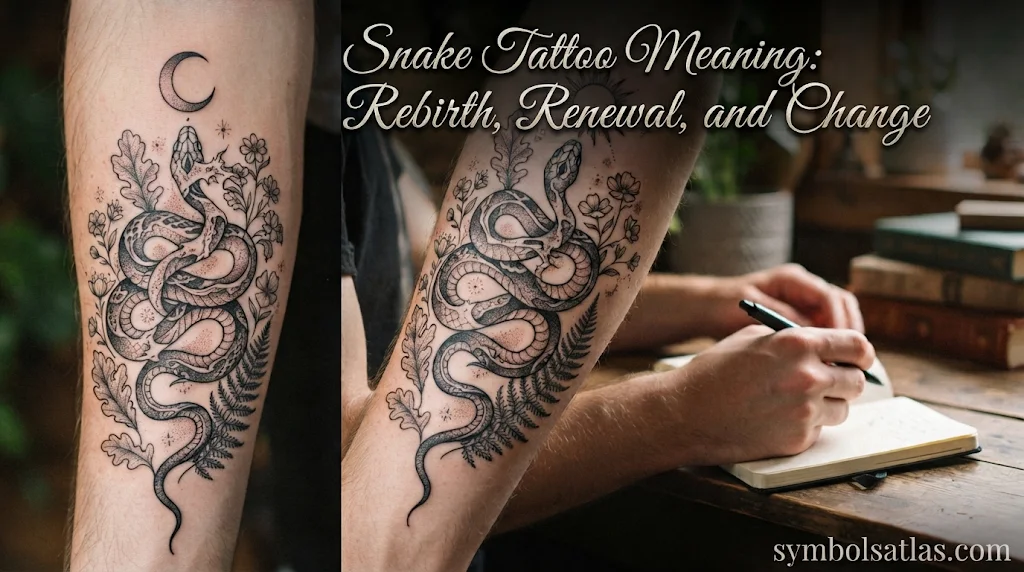

A snake tattoo is more than just a striking design; it carries deep meanings connected to transformation, rebirth, wisdom, and personal growth.
Across different cultures, snakes have represented both danger and healing, making them powerful symbols of life’s many changes. The snake tattoo meaning can vary depending on its design, cultural background, and personal significance. For some people, a snake represents transformation and renewal because it sheds its skin and begins again. Others associate it with protection, strength, wisdom, and resilience. In ancient traditions, snakes were also connected to healing, spiritual energy, and the mysteries of life. Whether the snake is wrapped around a flower, shown with its mouth open, or designed in a simple outline, each style can communicate a different message. Understanding these interpretations helps you discover why snake tattoos remain popular and meaningful.
In modern tattoo culture, a snake tattoo can express a personal journey, a new beginning, or the courage to face difficult experiences. Its meaning may also change depending on its colors, body position, and accompanying elements, such as roses, skulls, daggers, or butterflies. In some traditions, snakes symbolize fertility, eternity, protection, and spiritual awakening, while others connect them with temptation or danger. There is no single meaning that applies to everyone. Your personal experiences, beliefs, and artistic preferences all influence what this powerful symbol represents. Exploring the different interpretations can help you understand the deeper symbolism behind this timeless tattoo design.
Quick Answer
The Spiritual Meaning of Snake Tattoo: Rebirth represents transformation, renewal, and the courage to leave old experiences behind. In American tattoo culture, it often expresses personal growth, resilience, independence, and the beginning of a new chapter. Spiritually, the snake can also symbolize healing, wisdom, protection, and the continuous cycle of life.
TL;DR
- Snake tattoos commonly symbolize rebirth, renewal, and personal transformation.
- Shedding skin represents leaving old habits and experiences behind.
- Ancient Egyptian and Greek traditions connected snakes with renewal and healing.
- In American culture, rattlesnakes can represent independence and resistance.
- Different colors and designs create additional symbolic meanings.
- Modern snake tattoos often celebrate strength, growth, and new beginnings.
What Does a Snake Tattoo Symbolize?
A snake tattoo carries several meanings, depending on its design and the person’s intentions. For many Americans, it represents the ability to grow beyond previous experiences and embrace a different direction in life.
The snake’s natural behavior makes it especially meaningful. When it sheds its old skin, a new layer appears underneath. This process creates a strong image of renewal and personal development.
The Main Symbolic Meanings
Here are some common interpretations associated with snake tattoos:
- Rebirth: Leaving an old chapter behind and beginning again.
- Transformation: Accepting personal changes and discovering new possibilities.
- Wisdom: Learning from experiences and making thoughtful decisions.
- Healing: Moving forward after emotional or personal difficulties.
- Protection: Representing strength, awareness, and personal boundaries.
- Resilience: Continuing through difficult changes without losing hope.
However, not every snake tattoo carries all these meanings. Its symbolism depends on the artwork and the story behind it.
Why Rebirth Is So Important
Rebirth doesn’t always mean starting life completely over. Sometimes, it represents changing your mindset, discovering your values, or developing a stronger sense of identity.
For example, someone might choose a snake tattoo after completing an important personal journey. The design becomes a reminder that their past experiences don’t have to define their future.
The Historical Origins of Snake Rebirth Symbolism
Snake symbolism is much older than modern tattoo culture. Ancient societies observed the animal’s ability to shed its skin and connected this natural process with renewal, life, and spiritual change.
Over time, these interpretations appeared in religious artwork, mythology, jewelry, and traditional decorations.
Ancient Egyptian Symbolism
In ancient Egypt, snakes carried both protective and spiritual meanings. Several Egyptian deities appeared in serpent form or used snake imagery.
The shedding of skin connected snakes with renewal and rebirth. This made them meaningful symbols in beliefs about life, death, and the afterlife.
The Egyptian goddess Wadjet, often represented as a cobra, was associated with protection and royal authority. Snake imagery also appeared in objects connected with spiritual protection.
Ancient Greek Symbolism
Ancient Greek culture also gave snakes important symbolic roles. The god Asclepius, associated with medicine and healing, was commonly represented with a snake wrapped around a staff.
This image became one of history’s most recognizable medical symbols.
The snake’s ability to shed its skin also connected it with rejuvenation. Therefore, its image represented the possibility of renewal and restored life.
The Ouroboros and Eternal Renewal
<escape>The Ouroboros is an ancient symbol showing a snake eating its own tail.</escape>
It represents cycles, continuity, eternity, and the relationship between endings and beginnings. Its circular shape suggests that life continues through repeated periods of change.
For someone interested in rebirth, an Ouroboros tattoo can represent the idea that every ending creates space for another beginning.
The Spiritual Meaning of Snake Tattoos in American Culture
In the United States, snake tattoos combine traditional symbolism with personal expression. People often choose them to represent independence, courage, transformation, and the strength to face life’s changes.
American history has also influenced how people understand snake imagery.
The American Rattlesnake Symbol
The rattlesnake became an important symbol during the American Revolution. Benjamin Franklin’s famous 1754 political cartoon, “Join, or Die,” used a divided snake to encourage unity among the colonies.
Later, the rattlesnake appeared on the Gadsden flag, designed in 1775. Its coiled shape and warning message became associated with independence and resistance to control.
Today, this historical imagery can carry different political and personal meanings. However, not every rattlesnake tattoo represents a political position.
Independence and Personal Strength
For many Americans, a snake tattoo represents the importance of standing independently.
It can express the belief that personal growth requires courage and the willingness to make difficult changes.
Some people also connect it with protecting their identity and maintaining personal boundaries.
A Symbol of Personal Reinvention
Modern American tattoo culture often treats body art as a form of storytelling. A snake can represent a meaningful transition, such as leaving behind an old lifestyle or discovering a new purpose.
This interpretation makes the snake especially meaningful for people who associate rebirth with personal development.
Different Spiritual Meanings of Snake Tattoos
Snake symbolism appears in many spiritual traditions. However, its interpretation isn’t universal, and different cultures understand the animal in different ways.
Understanding these differences helps readers appreciate the symbol without assuming every tradition gives it the same meaning.
Hindu Traditions and Nagas
In Hindu traditions, nagas are serpent beings associated with water, protection, fertility, and spiritual power.
They appear in religious stories and artwork, sometimes protecting sacred places or representing powerful natural forces.
For some people, serpent imagery can therefore suggest spiritual energy, protection, and transformation. However, Hindu traditions are diverse, and snake symbolism has several different interpretations.
Buddhist Traditions
Serpent beings called nagas also appear in Buddhist traditions.
One well-known story describes a naga protecting the Buddha during meditation by sheltering him from a storm. This image connects the serpent with protection and spiritual devotion.
Consequently, snake imagery in some Buddhist artwork represents guardianship and the protection of sacred teachings.
Judeo-Christian Interpretations
In the Bible, the serpent appears in different stories with different meanings.
In Genesis, the serpent is connected with temptation and disobedience. However, another biblical story describes Moses raising a bronze serpent as part of a healing event.
These examples demonstrate why snake imagery doesn’t have one fixed religious interpretation.
Emotional and Psychological Meaning of a Snake Tattoo
Beyond its historical and spiritual background, a snake tattoo can carry deeply personal emotional meaning. People often connect the design with experiences that changed their outlook or helped them understand themselves better.
For American audiences, this personal interpretation is especially important because tattoos frequently communicate identity and life experiences.
Leaving the Past Behind
The shedding of skin offers a powerful metaphor for emotional renewal.
A person might associate a snake tattoo with moving beyond an old identity, releasing outdated expectations, or accepting a different direction.
It can represent the idea that personal growth doesn’t require forgetting the past. Instead, it involves learning from previous experiences.
Confidence and Inner Strength
Snakes are often viewed as alert, adaptable, and powerful creatures.
Their imagery can represent confidence, independence, and the ability to respond thoughtfully to changing situations.
A snake tattoo may remind someone to trust their judgment and recognize their own strengths.
Accepting Change
Change can feel uncomfortable, especially when it involves leaving familiar situations.
However, the snake’s natural shedding process offers a visual reminder that renewal is part of life.
For some people, this tattoo represents accepting change instead of resisting every new experience.
Snake Tattoo Colors and Their Spiritual Meanings
Color can influence the way people interpret snake tattoos. Although no universal color system exists, certain shades have become associated with particular emotions and ideas.
The following interpretations reflect common modern artistic and symbolic associations.
| Snake Tattoo Color | Symbolic Meaning | Common Associations |
| Black | Mystery and transformation | Strength, independence, and change |
| Green | Renewal and growth | Nature, balance, and new beginnings |
| Red | Passion and courage | Energy, confidence, and determination |
| White | Purity and renewal | Clarity, peace, and fresh starts |
| Gold | Wisdom and abundance | Success, knowledge, and prosperity |
| Blue | Calmness and awareness | Peace, understanding, and emotional balance |
Black Snake Tattoo
A black snake tattoo often represents mystery, strength, and transformation.
Its dark appearance can also suggest overcoming uncertainty and entering a new stage of life.
For people interested in rebirth, black may represent the unknown period between an ending and a beginning.
Green Snake Tattoo
Green is commonly associated with nature, growth, and renewal.
A green snake can therefore express a connection with personal development and fresh opportunities.
It may also represent the natural cycle of change and the importance of remaining open to growth.
White Snake Tattoo
White snake imagery can represent purity, peace, clarity, and spiritual renewal.
Some people associate it with releasing old burdens and approaching life with a fresh perspective.
However, its meaning can change considerably across different artistic and cultural traditions.
Read More: Spiritual Meaning of Sparrow Bird: Hope and Protection
Popular Snake Tattoo Designs and Their Meanings
Snake tattoos appear in many artistic styles. Some designs focus on realistic details, while others use simple outlines, traditional patterns, or symbolic combinations.
The design itself can influence how viewers understand the tattoo.
Snake and Flower Tattoo
A snake combined with a flower represents the relationship between strength and beauty.
Flowers often symbolize growth, love, or new beginnings. When paired with a snake, the design can express personal transformation and the ability to grow through changing circumstances.
Snake and Butterfly Tattoo
The butterfly is widely associated with transformation because of its life cycle.
Together, a snake and butterfly can create a strong visual representation of renewal, freedom, and personal development.
This combination may appeal to people who want to celebrate an important life transition.
Ouroboros Snake Tattoo
An Ouroboros tattoo shows a snake forming a circle by biting its tail.
Its circular design represents continuity, repeated cycles, and the relationship between endings and beginnings.
It can communicate the idea that transformation is an ongoing part of life.
Coiled Snake Tattoo
A coiled snake often appears alert and ready to respond to its surroundings.
Symbolically, this posture can represent awareness, patience, protection, and controlled strength.
Its meaning may also connect with independence and personal boundaries.
Snake With a Rose
A snake wrapped around a rose creates a contrast between beauty and danger.
The rose can symbolize love, passion, or emotional growth, while the snake may represent wisdom, transformation, or protection.
Together, they can express the complicated relationship between vulnerability and strength.
What Does a Snake Tattoo Mean for Personal Rebirth?
For many people, a snake tattoo represents a personal turning point. It can mark a period when someone begins understanding their identity differently or decides to move toward a new future.
However, rebirth doesn’t need to involve one dramatic event.
Starting a New Chapter
A new chapter might involve changing priorities, discovering a meaningful interest, or developing a different outlook.
A snake tattoo can serve as a personal symbol of that transition.
Learning From Previous Experiences
Rebirth doesn’t mean pretending the past never happened.
Instead, it can represent recognizing valuable lessons and carrying that knowledge into future experiences.
Becoming More Self-Aware
Some people connect snake symbolism with self-discovery.
The tattoo may represent understanding personal values, recognizing individual strengths, and becoming more comfortable with change.
Snake Tattoos in Modern Fashion and Popular Culture
Snake imagery remains recognizable in modern American visual culture. It appears in artwork, clothing, jewelry, illustrations, and tattoo designs.
Its popularity comes partly from its flexible symbolism. The same animal can communicate strength, mystery, beauty, protection, or transformation.
Tattoo Art and Personal Identity
Modern tattoo culture often uses animals to communicate personal values.
A snake design can represent a meaningful experience without requiring a written explanation.
Some people choose realistic snakes, while others prefer minimalist outlines, geometric patterns, or traditional artwork.
Social Media and Digital Expression
Snake imagery also appears in digital illustrations and social media designs.
People sometimes use serpent symbols to communicate themes of transformation, mystery, confidence, and personal reinvention.
However, an image’s meaning depends on its surrounding context. A snake emoji or illustration doesn’t automatically communicate spiritual rebirth.
Home Decor and Fashion
Snake patterns appear in decorative artwork, accessories, clothing, and jewelry.
Some designs emphasize the animal’s natural beauty, while others highlight its historical associations with wisdom and renewal.
These modern uses show how an ancient symbol continues to influence everyday visual culture.
Misunderstandings and Controversies About Snake Tattoos
Snake tattoos sometimes create confusion because different traditions associate serpents with very different ideas.
One person may see a snake as a symbol of healing, while another may connect it with temptation or danger.
Neither interpretation automatically defines every snake design.
Are Snake Tattoos Always Negative?
No. Snake tattoos don’t always represent evil, danger, or deception.
Ancient Egyptian and Greek traditions also connected snakes with renewal, protection, and healing.
Therefore, understanding the design requires considering its historical background and personal meaning.
Do Snake Tattoos Always Represent Rebirth?
No. Rebirth is one popular interpretation, but it’s not the only one.
Some designs emphasize wisdom, independence, protection, or personal strength.
The surrounding artwork and the person’s intentions help determine its meaning.
Cultural and Religious Sensitivity
Snake imagery has important meanings in several living religious and cultural traditions.
For example, naga imagery carries specific spiritual significance in Hindu and Buddhist traditions.
Using a culturally meaningful design without understanding its background can lead to misunderstandings. Learning about the original tradition encourages greater respect and appreciation.
Political Associations
The American rattlesnake and Gadsden flag have historical connections with independence and resistance.
Their modern use can also carry political associations. However, a traditional snake tattoo without that specific imagery shouldn’t automatically be interpreted as a political statement.
How Snake Tattoo Meanings Have Changed Over Time
Snake symbolism has never remained completely fixed. Its meanings have changed as societies developed new beliefs, artistic styles, and cultural traditions.
However, certain themes have remained recognizable across many generations.
Ancient Interpretations
Ancient Egyptians connected snakes with renewal, protection, and the afterlife.
Ancient Greeks also associated them with healing and the natural forces of life.
These interpretations helped establish the connection between snakes and the idea of regeneration.
Medieval and Religious Interpretations
During the medieval period, Christian artwork frequently used serpents to represent temptation, sin, and spiritual danger.
However, healing-related snake imagery continued to exist through the medical tradition associated with Asclepius.
This period demonstrates how contrasting meanings could exist at the same time.
Modern Interpretations
Today, snake tattoos often combine historical symbolism with individual storytelling.
People may connect them with personal growth, resilience, spiritual exploration, or independence.
The older association with rebirth remains especially meaningful because it reflects a natural process that people can easily understand.
FAQs
What Is the Spiritual Meaning of a Snake Tattoo?
A snake tattoo commonly symbolizes transformation, rebirth, wisdom, and renewal. Its meaning often comes from the snake’s ability to shed its skin and emerge with a fresh outer layer.
Does a Snake Tattoo Represent New Beginnings?
Yes, many people interpret snake tattoos as symbols of new beginnings. The shedding process represents leaving an earlier stage behind and welcoming personal growth.
Is a Snake Tattoo a Symbol of Healing?
Snake imagery has a long association with healing, particularly through the ancient Greek tradition of Asclepius. Today, some people use snake tattoos to represent recovery, renewal, and personal strength.
What Does a Black Snake Tattoo Symbolize?
A black snake tattoo often represents mystery, transformation, independence, and strength. Some people also connect its dark appearance with overcoming uncertainty and embracing change.
What Does a Snake Tattoo Mean in American Culture?
In American culture, snake imagery can represent independence, vigilance, courage, and personal freedom. Its historical connection with the American Revolution also gives the rattlesnake a distinctive national meaning.
Does a Snake Tattoo Have a Biblical Meaning?
In biblical traditions, serpents can represent temptation and disobedience, but other passages connect serpent imagery with healing. Therefore, the meaning depends on the specific biblical story and artistic context.
Conclusion
The Spiritual Meaning of Snake Tattoo: Rebirth centers on transformation, renewal, wisdom, and the courage to embrace change. Its symbolism comes from the snake’s natural ability to shed its skin, making it a lasting image of new beginnings. Throughout history, different cultures have also connected snakes with healing, protection, independence, and spiritual power. Today, snake tattoos let people express personal experiences and meaningful change through art.
Whether the design features a black serpent, a green snake, a flower, or an Ouroboros, its meaning can reflect an individual’s values and journey. Ultimately, a snake tattoo can remind us that growth doesn’t mean staying the same. Sometimes, moving forward means releasing what no longer represents us and welcoming the possibilities of a new chapter.