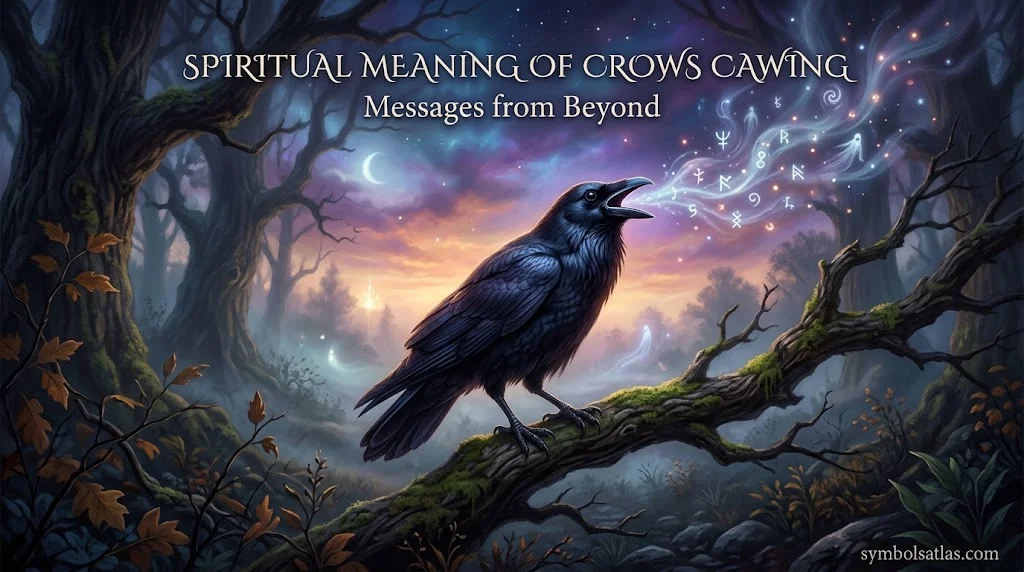

The Spiritual Meaning of Crows Cawing can inspire thoughts about awareness, reflection, intuition, and spiritual connection.
Crows belong to the oscine passerine bird family, and their vocalizations help them communicate with other crows in various ways. A crow caws at a human for many natural reasons, including communicating valuable information, giving a warning, signaling potential danger, defending territory, or responding to something nearby. A person may find a crow encounter frightening, especially after being cawed at repeatedly, but this does not automatically indicate a spiritual event. In the United States, crows have an important place in culture, Native traditions, folklore, literature, Halloween imagery, and nature writing. Ideas about clairvoyance, emotional attachment to humans, and other spiritual ideas have also influenced how people interpret crow encounters.
For people exploring the hidden meanings behind crow cawing, the experience may seem like a mystical call to awaken the spirit and remain vigilant about your surroundings. In some traditions, crows symbolize new beginnings, transformation, inner growth, and hidden truths, while omens and warning signs can encourage careful reflection. Spiritual interpretations may describe the physical domain and spiritual domain as connected through a link with the afterlife, secrets, and what lies beyond. Some people experience a deeper connection with departed souls, opening the heart to mysteries and profound insights. When experiencing frequent crow encounters, deciphering their possible significance can involve your emotions, circumstances, and personal beliefs, rather than assuming one universal explanation.
Quick Answer
The Spiritual Meaning of Crows Cawing: Messages from Beyond is often interpreted in the USA as a reminder to pay attention, trust your awareness, and notice possible changes around you. In broader spiritual traditions, crows may symbolize transformation, intelligence, mystery, protection, or communication between worlds.
TL;DR
- Crows often symbolize intelligence, awareness, mystery, and transformation.
- Repeated cawing can represent communication or a call to pay attention.
- American folklore gives crows both positive and darker associations.
- Ancient traditions connected corvids with prophecy, memory, and the unknown.
- Spiritual interpretations vary widely between cultures and individuals.
- A crow’s behavior also has ordinary natural explanations.
What Does It Mean When Crows Keep Cawing?
Crows are highly social birds, so their calls usually have a practical purpose. They communicate with one another about food, predators, territory, and group activity. Therefore, hearing repeated cawing doesn’t automatically indicate a supernatural message.
Still, people often give unusual encounters personal meaning. The interpretation becomes especially interesting when the same pattern appears during a major life change or emotional moment.
Common Spiritual Interpretations
Some modern spiritual readers associate repeated crow calls with:
- A reminder to become more observant
- An invitation to trust your intuition
- Awareness of an approaching transition
- Protection during an uncertain period
- A need to communicate honestly
- Reflection on something from the past
These ideas are symbolic rather than scientifically proven messages from another realm. Your personal beliefs and the circumstances surrounding the encounter can shape the meaning you take from it.
The Importance of Context
One crow calling outside your window may mean something different from a large group calling together. Time, location, behavior, and repetition can all change how people interpret the experience.
For example, a crow calling repeatedly near its nest may simply be defending its territory. Yet if the encounter makes you pause and reflect, that personal response can still have symbolic value.
Ancient Roots of Crow Symbolism
Crow symbolism reaches far beyond modern spiritual culture. Across history, people noticed that corvids were intelligent, adaptable, social, and comfortable in many environments.
Those qualities made them natural symbols of mystery and observation. Their dark feathers and scavenging behavior also connected them with death and the unknown in some traditions.
Crows in Ancient Mythology
In Norse mythology, ravens are strongly associated with Odin, who was linked with knowledge, wisdom, and war. Huginn and Muninn were said to travel throughout the world and return with information.
This tradition concerns ravens rather than American crows. However, both belong to the corvid family, which helps explain why similar symbolic ideas sometimes become blended in modern discussions.
Celtic and European Folklore
Various European traditions associated corvids with battlefields, prophecy, supernatural knowledge, or death. Their presence around places where people died contributed to these darker associations.
However, these traditions weren’t universally negative. Intelligence, foresight, and magical knowledge were also important parts of corvid symbolism.
Why Their Caw Became Symbolic
A crow’s voice is distinctive and sometimes startling. Before modern science explained animal communication, unfamiliar sounds were more easily connected with omens or supernatural events.
As a result, the crow’s call became part of stories about warnings, visitors, change, and hidden knowledge.
Crow Symbolism in the United States
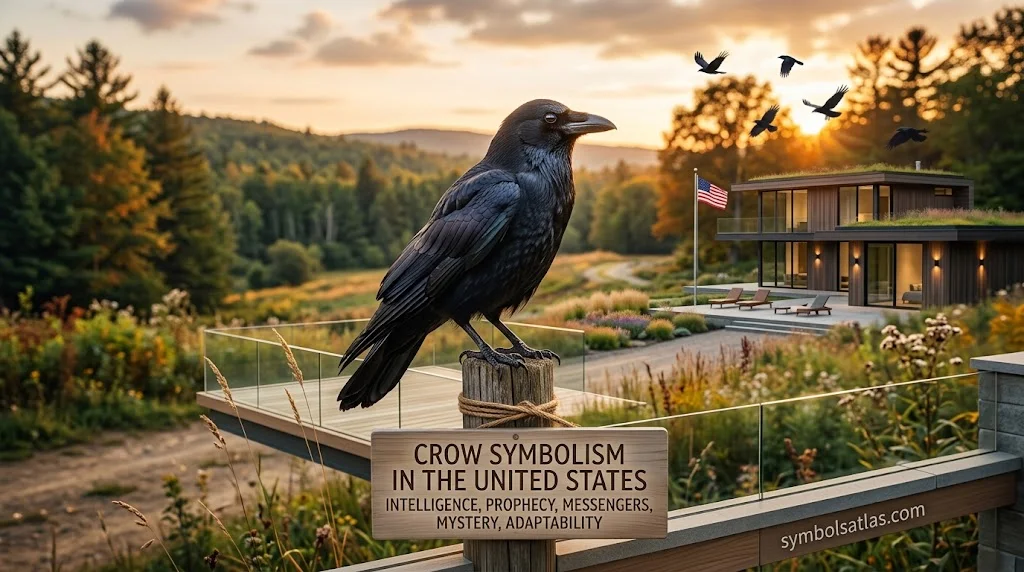
In the USA, crow symbolism has developed through several overlapping traditions. Indigenous cultures, European folklore, literature, farming communities, and popular entertainment have all influenced how Americans perceive these birds.
There is no single Native American meaning for crows. Indigenous nations have distinct histories and beliefs, so broad claims about one universal interpretation should be avoided.
A Familiar American Bird
American crows are common across much of the United States. Their adaptability means people encounter them in cities, suburbs, farmland, parks, and forests.
Because they’re so familiar, they can symbolize the relationship between nature and everyday life. A crow doesn’t need to appear in a remote wilderness to feel unusual.
Dark Symbolism and Popular Culture
American movies, books, Halloween decorations, and gothic artwork often portray crows as mysterious or ominous. This imagery has strengthened the connection between crows and darkness.
However, entertainment doesn’t represent every cultural or spiritual tradition. The frightening image is only one part of the broader symbolism.
A Symbol of Intelligence
Crows are also widely recognized for impressive problem-solving abilities. Their intelligence has encouraged a more positive modern image.
Today, a crow can symbolize:
- Intelligence and clever problem-solving
- Adaptability during difficult circumstances
- Curiosity about the unknown
- Strong social awareness
- Independence and resourcefulness
What Do Crows Represent Spiritually?
Spiritual interpretations often focus on what the crow does rather than simply how it looks. A crow watching you, flying overhead, calling repeatedly, or appearing during a transition can invite different interpretations.
The symbolism is personal, but several themes appear repeatedly in modern spiritual writing and folklore.
Communication
Because crows communicate constantly with one another, their calls naturally lend themselves to the symbolism of communication.
A cawing crow may therefore be viewed as a reminder to listen. It can also represent something you need to express rather than keep hidden.
Transformation
Crows are adaptable survivors. They thrive in changing environments and quickly adjust to new circumstances.
For that reason, some people view them as symbols of transformation and resilience. Seeing one during a major life transition can feel like a reminder that change doesn’t always mean loss.
Mystery and the Unknown
Their dark appearance and unusual behavior have long inspired mysterious imagery. In spiritual contexts, crows may represent questions that don’t have immediate answers.
Instead of predicting the future, this symbolism can encourage curiosity and patience.
What Does a Crow Cawing Mean at You?
A crow may sometimes appear to be calling directly at a person. Usually, however, the bird is responding to something in its environment.
Crows can recognize individual humans and remember experiences. Their behavior may therefore seem surprisingly personal.
A Symbolic Interpretation
If you personally experience the encounter as meaningful, you might reflect on:
- What were you thinking about before the crow appeared?
- Were you facing an important decision?
- Did the crow behave unusually?
- Have similar encounters happened repeatedly?
- What emotion did you feel immediately?
These questions can help you explore personal symbolism without assuming the bird delivered a literal supernatural message.
Why the Experience Can Feel Powerful
Unexpected encounters naturally capture attention. A sudden crow call during a quiet moment can interrupt ordinary thoughts and create a strong emotional impression.
That doesn’t prove a paranormal event occurred. It simply explains why symbolic experiences can feel deeply personal.
Is a Crow Cawing a Sign of a Message From Beyond?
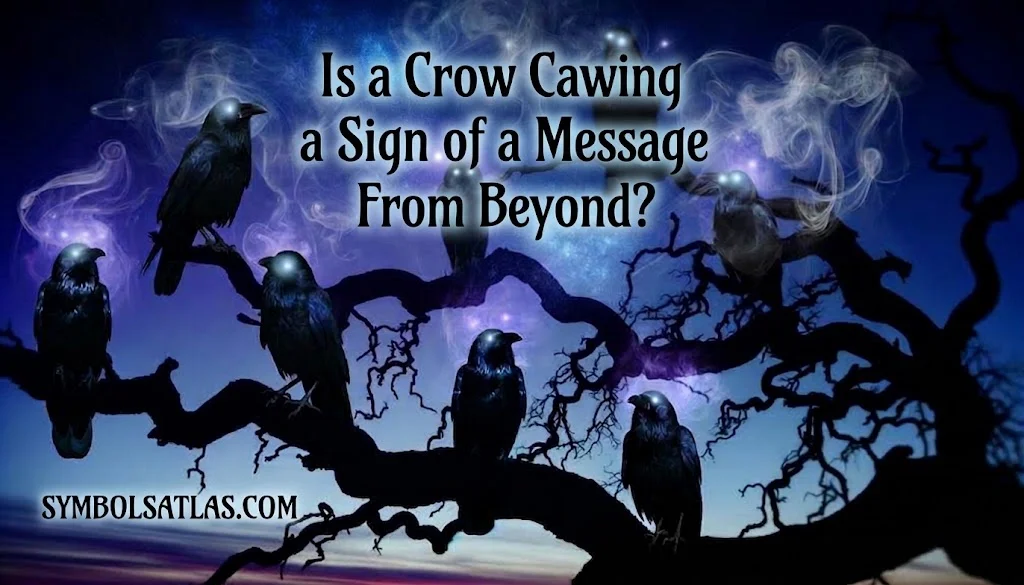
Some spiritual traditions and modern belief systems interpret animal encounters as meaningful signs. Within those beliefs, cawing may be viewed as communication from ancestors, spirits, or another spiritual realm.
However, there is no scientific evidence establishing that crows transmit messages from deceased people or supernatural beings.
Spiritual Belief Versus Natural Behavior
It’s useful to keep two ideas separate. The bird’s behavior can have a natural explanation, while your personal interpretation can still carry emotional meaning.
For example, a crow may call because another crow entered its territory. You might nevertheless use the encounter as a prompt to remember someone you love.
Both perspectives can exist without requiring a factual claim about the supernatural.
What Does Crow Cawing Mean in Different Situations?
The surrounding situation can strongly influence symbolic interpretation. A single crow at sunrise creates a different impression from dozens of crows gathering at sunset.
For an American reader, ordinary bird behavior should remain part of the picture.
| Situation | Common Spiritual Interpretation | Natural Explanation | Symbolic Theme |
| One crow calling | Attention or awareness | Communication with nearby birds | Awareness |
| Repeated cawing | A message or warning | Territorial or social calling | Communication |
| Crows gathering | Community or collective wisdom | Food, roosting, or social behavior | Connection |
| Crow near your home | Protection or observation | Food, shelter, or familiar surroundings | Security |
| Crow during a life change | Transformation | Coincidental timing | Transition |
These interpretations are not universal rules. They offer ways to reflect on an encounter while keeping natural behavior in view.
What Does It Mean When Crows Caw at Night?
Nighttime crow calls can feel particularly mysterious. Since crows are generally active during daylight, hearing one after dark may immediately attract attention.
However, unusual nighttime activity can have practical causes. Artificial lights, disturbances, predators, or nearby activity may affect bird behavior.
Spiritual Meaning of Night Cawing
Symbolically, nighttime represents the unknown, dreams, hidden feelings, and uncertainty. Therefore, a crow calling at night can be interpreted as a prompt to examine something you may be avoiding.
Some people associate it with:
- Hidden concerns coming into awareness
- A need for caution
- Intuition during uncertain circumstances
- Reflection before an important decision
- Moving through an unfamiliar stage of life
Again, these are symbolic interpretations rather than established supernatural meanings.
Emotional and Psychological Meaning of Crows
Crows can produce very different emotional reactions. Some people find them fascinating, while others associate them with fear or death.
Much of this response comes from cultural conditioning. Stories, movies, childhood experiences, and personal memories can influence how someone interprets a crow.
Why Crows Can Feel Mysterious
Their dark feathers, sharp calls, intelligence, and social behavior create a distinctive presence. They also live comfortably around humans without becoming completely tame.
That combination can make a crow feel both familiar and wild.
A Symbol of Inner Awareness
Modern symbolic interpretation often turns the crow into a metaphor for paying attention. The bird’s reputation for intelligence makes it especially suitable for themes of observation and learning.
If a crow encounter makes you stop and think, the useful question may be less “What will happen?” and more “What am I noticing now?”
Read More: Spiritual Meaning of Orange Butterfly: Transformation
Crows, Death, and Spiritual Transformation
Crows are often connected with death, but that symbolism needs careful context. Their association partly comes from scavenging behavior and their presence around battlefields in historical settings.
Modern spiritual interpretations sometimes soften this meaning by connecting death with endings rather than literal physical death.
Symbolic Death Versus Literal Death
In spiritual language, “death” can represent the ending of a relationship, habit, identity, job, or stage of life.
Under this interpretation, a crow may symbolize:
- Letting go of an outdated pattern
- Accepting the end of a chapter
- Making room for something different
- Learning from past experiences
This approach can make the symbolism more reflective and less frightening.
Why Literal Predictions Can Be Misleading
A crow outside your house doesn’t reliably predict death or tragedy. Such claims can create unnecessary fear.
A more grounded interpretation treats the encounter as a symbolic opportunity rather than a prediction.
Crows in Dreams and Social Media Today
Crows remain popular symbols in modern American visual culture. Their recognizable silhouette works well in tattoos, artwork, photography, clothing, and online content.
On social media, a crow may represent mystery, independence, nature, intelligence, or a darker aesthetic.
Crow Tattoos
A crow tattoo can have highly personal meaning. Some people choose the image for intelligence or independence, while others connect it with remembrance or transformation.
The meaning depends on the design and the person’s story. A flying crow may suggest freedom, while a perched crow can suggest observation or patience.
Home Decor and Art
Crow imagery often appears in gothic, autumn, Halloween, and nature-inspired decorations. Black silhouettes are especially popular because they’re visually simple and recognizable.
However, crow imagery isn’t limited to spooky themes. Contemporary artwork may use crows to represent intelligence, adaptability, or the beauty of wildlife.
Why Do People Believe Crows Carry Messages?
Humans naturally look for patterns, especially during emotional or uncertain periods. An unexpected animal encounter can become meaningful because it arrives at a memorable moment.
Crows are especially suited to this role because people already associate them with communication and intelligence.
Personal Meaning Matters
A symbolic interpretation doesn’t have to be universal to be meaningful. Someone grieving a loved one may associate a crow with remembrance, while another person may see the same bird as a sign of independence.
Neither interpretation can automatically be presented as a universal fact.
Reflection Instead of Prediction
A healthy symbolic approach focuses on reflection rather than certainty. Ask what the encounter brings to mind instead of assuming it reveals a fixed future.
That distinction keeps spiritual exploration personal and respectful.
Crow Symbolism Across Cultures
Crow and raven symbolism differs significantly around the world. In some traditions, corvids are linked with wisdom or divine knowledge. In others, they may carry associations with death, trickery, or transformation.
These meanings shouldn’t be treated as interchangeable.
Norse Traditions
Ravens associated with Odin became symbols of knowledge, observation, and information. This is one reason modern audiences sometimes connect corvids broadly with wisdom.
Indigenous North American Traditions
Different Indigenous nations have their own teachings about crows and ravens. In some traditions, corvid figures can appear as tricksters, creators, helpers, or powerful beings.
There isn’t one universal Indigenous interpretation. Specific traditions should be understood on their own terms.
East Asian Traditions
In parts of East Asian mythology, crows and ravens can carry meanings that differ from the darker Western image. The three-legged crow, for example, has appeared in Chinese and Japanese mythology in connection with the sun.
This demonstrates why a crow shouldn’t automatically be treated as a symbol of bad luck.
Misunderstandings and Controversies About Crow Symbolism
Crow symbolism can become misleading when one interpretation is presented as universal. History shows that meanings change between cultures and across centuries.
Another common mistake is treating folklore as scientific evidence.
Common Misunderstandings
Some claims deserve careful treatment:
- A crow doesn’t automatically predict death.
- Cawing doesn’t prove supernatural communication.
- Black feathers don’t inherently represent evil.
- One cultural meaning can’t represent every tradition.
- Crow behavior often has ordinary ecological explanations.
Keeping these distinctions clear allows symbolism to remain interesting without turning interpretation into fact.
Why Meanings Change
Symbols aren’t permanent dictionaries. Literature, religion, entertainment, personal experience, and social media can all reshape them.
As a result, the modern American crow can represent both darkness and intelligence, depending on context.
How Crow Meaning Has Changed Over Time
Crow symbolism has moved through several overlapping stages. Ancient and medieval stories often emphasized prophecy, death, battle, or supernatural knowledge.
Later, literature and popular entertainment strengthened the mysterious image. Today, however, scientific interest in crow intelligence has added another layer.
From Omen to Intelligent Wildlife
Modern knowledge has changed how many Americans understand crows. Researchers have documented sophisticated behavior in corvids, including problem-solving and complex social interactions.
This doesn’t erase older symbolism. Instead, it gives the crow another identity: a remarkable animal that also happens to carry centuries of human stories.
A More Balanced Modern Meaning
Today, crows can represent both mystery and intelligence. They may symbolize change without necessarily suggesting something negative.
That broader view allows people to appreciate the bird itself while exploring the symbolism surrounding it.
How to Reflect When You Hear Crows Cawing
If repeated cawing catches your attention, you don’t need to decide immediately whether it was a sign. Instead, use the moment as a chance to become more observant.
Notice the environment first. Then consider your emotional response and the circumstances surrounding the encounter.
Questions to Ask Yourself
You might quietly consider:
- What was happening in my life when I heard the crows?
- What emotion did their calls bring up?
- Am I ignoring an important conversation?
- Am I moving through a major transition?
- What do crows personally symbolize to me?
This approach keeps the experience meaningful without claiming certainty about something that can’t be verified.
FAQs
What is the spiritual meaning of crows cawing?
The spiritual meaning of crows cawing is often associated with communication, awareness, intuition, change, protection, and transformation. Some spiritual traditions view repeated crow calls as a reminder to pay attention to your surroundings and inner feelings. However, there is no single universal meaning.
What does it mean when a crow caws at you?
A crow may caw at a person for ordinary reasons, such as communicating with other crows, warning about danger, defending territory, or responding to something nearby. Spiritually, some people interpret the encounter as a sign to become more aware or reflective.
Is hearing crows a sign from the spirit world?
Some spiritual beliefs connect crows with messages from beyond, the afterlife, and spiritual awareness. These interpretations are part of folklore and personal belief rather than scientifically established facts. A crow’s behavior can also have a completely natural explanation.
What does it mean when crows caw repeatedly?
Repeated cawing may indicate communication, territorial behavior, a warning, or another response to the environment. From a spiritual perspective, people may see repeated calls as an omen, a prompt for inner growth, or an invitation to notice something important in their lives.
Are crows considered spiritual messengers?
Yes, crows are considered messengers in some cultural and spiritual traditions. Their intelligence, vocal behavior, and presence in folklore have contributed to this symbolism. Their meaning can vary depending on the culture, personal beliefs, and circumstances surrounding the encounter.
Conclusion
The Spiritual Meaning of Crows Cawing can be explored through ideas of communication, intuition, awareness, change, protection, and transformation. For some people, a repeated crow call feels like a meaningful moment that encourages reflection, while others may understand it through natural crow behavior.
Whether you see crows as spiritual messengers or fascinating birds responding to their environment, their presence can encourage you to pause and observe. The meaning you attach to a crow encounter may depend on your personal experiences, beliefs, emotions, and the circumstances in which the cawing occurs.