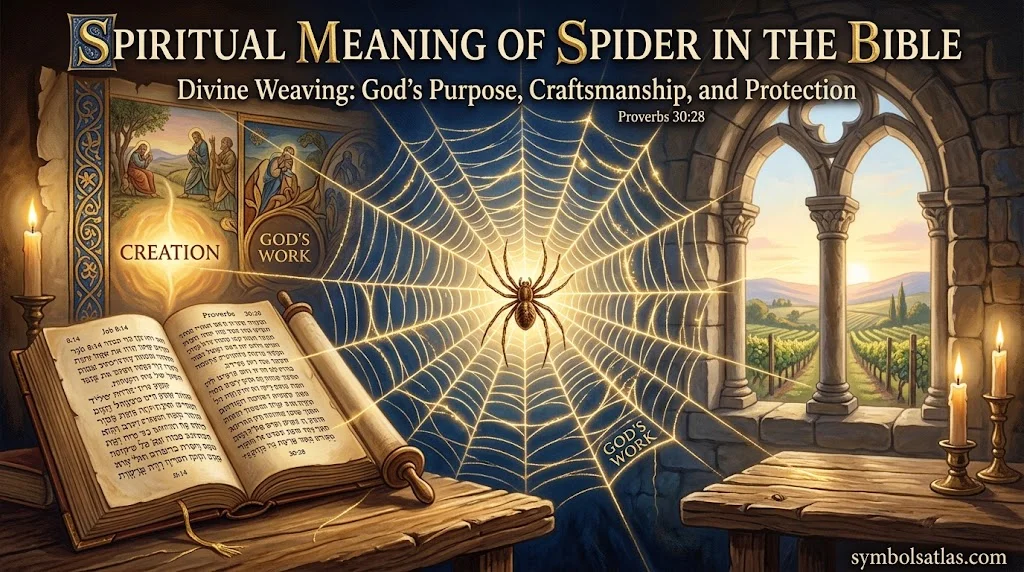

The spiritual meaning of the spider in the Bible offers fascinating insights into wisdom, patience, human weakness, and spiritual reflection.
Although spiders are not discussed extensively in Scripture, their webs appear in meaningful biblical passages. In the Bible, spiders and their webs can symbolize both wisdom and fragility, depending on the context. Proverbs 30:28 describes a spider that can be caught by hand yet is found in kings’ palaces, highlighting its remarkable ability to survive and thrive in unexpected places. This image encourages readers to reflect on determination, resourcefulness, and humble strength. Spiritually, the spider may remind you that even small creatures can demonstrate extraordinary abilities. Its presence can inspire you to recognize the value of patience, appreciate life’s hidden lessons, and remain faithful during challenging seasons.
Another important biblical connection appears in Job 8:14, which compares misplaced confidence to a spider’s web, emphasizing how fragile human security can become when it rests on unreliable foundations. This passage encourages believers to examine their faith, priorities, and trust in God rather than depending entirely on worldly possessions or personal achievements. While some modern spiritual interpretations associate spiders with creativity, protection, and divine timing, these meanings should be distinguished from the Bible’s direct teachings. To understand the spiritual symbolism of spiders in the Bible, consider the surrounding verses and their original message. By exploring these passages, you can discover meaningful lessons about humility, perseverance, and building your life on a strong spiritual foundation.
Quick Answer
The spiritual meaning of a spider in the Bible centers on the fragility of false security, the consequences of wrongdoing, and the importance of building life on a dependable foundation. In American Christian discussions, a spider’s web may also inspire personal reflection on patience, creativity, and the complexity of life. However, divine weaving is a modern symbolic interpretation, not a direct biblical teaching about spiders.
TL;DR
- Fragility: A spider’s web illustrates how easily misplaced confidence can collapse.
- Wisdom: Proverbs celebrates the resourcefulness of small creatures, although its spider translation is debated.
- Divine weaving: A modern metaphor for life’s connections, not an explicit biblical doctrine.
- Spiritual reflection: Spider imagery can encourage humility, patience, and thoughtful choices.
- American culture: Spiders appear in Halloween decorations, tattoos, art, and spiritual conversations.
- Historical context: Biblical meanings differ from spider symbolism in other cultural traditions.
Overview of Spider Symbolism in the Bible
The spider is a small creature with an impressive ability to produce delicate silk. Its web can look beautiful and carefully designed, yet it can also be damaged with little effort. This contrast helps explain why biblical writers used spider-web imagery to communicate lessons about human confidence and the results of wrongdoing.
What Does a Spider Represent?
In biblical interpretation, the spider’s meaning depends on the passage rather than the animal alone.
- Fragile security: A web represents something that appears dependable but cannot withstand pressure.
- Fruitless effort: A carefully woven structure may still fail to provide lasting protection.
- Resourcefulness: A spider demonstrates how a small creature can accomplish complex work.
- Human limitations: The web reminds readers that skill alone cannot guarantee lasting security.
The first two meanings are closely connected to biblical passages. The latter two are broader reflections drawn from nature and should not be confused with direct scriptural claims.
What Is Divine Weaving?
The phrase divine weaving describes the idea that individual experiences, relationships, and decisions can form a larger pattern over time. People may use a spider’s web to visualize how different parts of life connect.
However, the Bible does not specifically identify spiders as messengers of divine plans. Christians may connect the web’s interconnected structure with broader biblical themes of providence, wisdom, and community, but that connection is interpretive.
Biblical Verses About Spiders and Their Webs
The clearest biblical references appear in Job and Isaiah. These passages use spider-web imagery to make moral and spiritual points rather than to explain supernatural messages.
Job 8:14 — The Fragility of False Confidence
Job 8:14 compares misplaced confidence to a spider’s web. In the context of the passage, Bildad, one of Job’s companions, argues that the hope of someone who forgets God is fragile.
Importantly, Bildad’s speech belongs to a larger debate about Job’s suffering. The Book of Job challenges simplistic explanations of suffering, so readers shouldn’t treat every statement made by Job’s companions as the book’s final answer.
The spider’s web nevertheless provides a clear image: something can appear carefully constructed while remaining unable to support the weight placed upon it.
Isaiah 59:5–6 — Works That Cannot Protect
Isaiah 59 describes wrongdoing through the image of people weaving spider webs. Their creations cannot become proper clothing or provide meaningful protection.
The wider passage addresses injustice, dishonesty, and the separation between people and righteousness. Consequently, the web represents the inadequacy of harmful actions and schemes.
For modern readers, this imagery encourages an important question: Are our choices creating something genuinely good, or merely something that looks convincing?
Proverbs 30:28 — A Translation Worth Understanding
Some translations of Proverbs 30:28 mention a spider that can be found in kings’ palaces. The verse describes a small creature displaying remarkable resourcefulness despite its size.
However, the original Hebrew word is commonly understood in modern scholarship as referring to a lizard or gecko, rather than a spider. The King James Version famously renders it as a spider.
Therefore, this verse can support a traditional reflection on small creatures and resourcefulness, but readers should acknowledge the translation difference instead of presenting it as an undisputed reference to spiders.
Read More: Spiritual Meaning of Three Crows: Prophetic Signs
The Spiritual Meaning of a Spider’s Web
A spider’s web is often the most meaningful part of spider imagery because it reveals the tension between delicate beauty and practical strength. Biblical passages emphasize its limitations, while modern spiritual reflection sometimes focuses on its intricate design.
A Symbol of Fragile Foundations
A web may look secure until wind, rain, or a passing object destroys it. Similarly, a person might place excessive confidence in wealth, reputation, relationships, or personal achievements.
The biblical lesson isn’t that these things have no value. Instead, it asks whether they have become the sole foundation of a person’s identity and sense of security.
A Symbol of Connection and Creation
In contemporary spirituality, a web can represent the relationships and experiences that connect different parts of life. Each strand contributes to the larger structure, making the web a useful image for interdependence.
This interpretation can encourage people to reflect on how their decisions affect others. Still, the web as a symbol of divine interconnectedness is a modern interpretive idea, not the central meaning of the spider passages in Job and Isaiah.
A Symbol of Temporary Security
The web also reminds us that something can be useful without being permanent. A person’s plans may work for a season, yet circumstances can change unexpectedly.
From a Christian perspective, this can inspire reflection on humility, spiritual priorities, and the difference between temporary comfort and enduring faith.
Historical Origins of Spider Symbolism
Spider symbolism existed in many societies long before modern spiritual blogs, tattoos, and social media. People observed spiders weaving, hunting, and surviving, then incorporated those behaviors into stories about creation, wisdom, fate, and human character.
Ancient Near Eastern Associations
The ancient Near East included many cultures with rich traditions of storytelling and religious imagery. Spiders naturally attracted attention because of their silk, intricate webs, and unusual movements.
However, evidence for a particular spider meaning in one ancient culture shouldn’t automatically be treated as evidence for another. The biblical references have their own literary context, focused primarily on the limitations of human confidence and wrongdoing.
Greek and Roman Traditions
In Greek mythology, Arachne is a skilled mortal weaver who challenges Athena, the goddess associated with wisdom and crafts. In the familiar version of the story, Arachne’s contest with the goddess ends tragically, and she becomes a spider.
The story explores pride, skill, rivalry, and punishment. Roman poet Ovid preserved a well-known version in Metamorphoses.
Although this myth shares the theme of weaving with modern spider symbolism, it isn’t part of the Bible and shouldn’t be merged with Christian teachings.
How Meanings Changed Over Time
Across centuries, spiders acquired different associations through religious art, folklore, literature, and popular entertainment. Some traditions emphasized danger or deception, while others highlighted creative skill or the power to connect things.
Today, people can encounter several interpretations simultaneously. Understanding their origins helps prevent modern ideas from being mistaken for ancient biblical teachings.
Spider Symbolism in American Christian Culture
In the United States, spider imagery appears in churches, family conversations, nature education, popular media, and personal spiritual practices. Its meaning often depends on whether someone is reading Scripture, discussing nature, or interpreting a personal experience.
Lessons About Faith and Humility
American Christians may use the spider’s web as a reminder that human achievements cannot guarantee lasting security. The imagery can encourage humility without suggesting that hard work or careful planning is worthless.
For example, a person experiencing a major life change might reflect on which values remain dependable when familiar routines disappear.
Spiders in Everyday American Life
American culture also gives spiders meanings unrelated to biblical interpretation.
- Halloween decorations often use webs to create an eerie atmosphere.
- Children’s stories sometimes portray spiders as clever, helpful, or misunderstood.
- Nature photography highlights the beauty of webs covered in morning dew.
- Tattoos may express creativity, independence, resilience, or an interest in darker imagery.
These associations are shaped by cultural context, not by a single religious definition.
Biblical Meaning Versus Popular Belief
Some online spiritual discussions describe a spider’s appearance as a sign that God is arranging events behind the scenes. Others associate it with protection, prosperity, or an approaching opportunity.
Such interpretations may feel personally meaningful, but the Bible does not establish a universal message attached to seeing a spider. A Christian reader can reflect on an encounter without assuming it predicts a particular event.
Cross-Cultural and Spiritual Meanings of Spiders
Spider symbolism varies considerably around the world. Comparing traditions can reveal shared human fascination with weaving while preserving the differences between religious teachings and cultural stories.
Indigenous Traditions of North America
Some Indigenous traditions feature Spider Woman or Spider Grandmother as a significant figure associated with creation, teaching, protection, or weaving. Specific stories differ among communities, including Hopi and Diné traditions.
These teachings belong to living cultural and spiritual traditions. They should be approached on their own terms rather than treated as extensions of biblical symbolism.
Greek Mythology and the Art of Weaving
The story of Arachne connects spiders with artistic skill, pride, and the consequences of challenging divine authority. This provides a useful comparison with biblical reflections on human limitations.
However, the stories differ in their religious frameworks and lessons. Similar imagery does not prove that the traditions share one original meaning.
Modern Spiritual Interpretations
Contemporary spiritual communities may associate spiders with patience, creativity, intuition, or the connections between events.
These meanings can function as personal metaphors. Nevertheless, they should be described as contemporary spiritual interpretations rather than universal beliefs shared by all religions.
Emotional and Psychological Meaning of Spiders
A spider can create very different emotional responses. Some people admire its web, while others experience fear or disgust. These reactions influence how people interpret spider imagery in personal and spiritual contexts.
Patience and Focus
Watching a spider build its web can draw attention to persistence and careful work. Its behavior provides a natural example of how complex results can emerge through repeated actions.
A person might use this image as a reminder to approach a difficult goal gradually rather than expecting instant progress.
Fear and Vulnerability
Spiders are common sources of fear, sometimes called arachnophobia when the fear is intense and persistent. Their many legs, sudden movements, and association with venomous species can influence public perception.
From a symbolic perspective, a spider may represent an uncomfortable feeling or an uncertain situation. That interpretation reflects personal associations rather than a fixed spiritual message.
Reflection and Personal Meaning
When a spider catches your attention, you might consider what was happening at the time. Were you thinking about a difficult decision, feeling overwhelmed, or simply noticing an interesting part of nature?
These questions can help you explore personal meaning without treating an ordinary encounter as proof of supernatural communication.
What Does It Mean When You See a Spider?
Seeing a spider in your home, garden, or workplace can inspire curiosity. However, its presence doesn’t automatically indicate a divine warning, blessing, or prediction.
Seeing a Spider in Your House
In everyday life, a spider indoors usually has a natural explanation. It may have entered through an opening, followed available prey, or found a suitable place to build a web.
If you choose to reflect spiritually, you might use the experience as an opportunity to consider patience, humility, or the foundations of your life. The reflection can be valuable without claiming that God sent the spider as a specific sign.
Seeing a Spider Build a Web
A spider constructing a web can serve as a metaphor for steady effort and careful planning. Each strand contributes to the larger structure, illustrating how small actions can gradually create something useful.
This can be a helpful personal reminder when working toward a meaningful goal. However, the association with purposeful divine design remains an interpretation rather than a direct biblical teaching.
Seeing a Spider Repeatedly
Repeated encounters may seem significant, especially when they occur during a stressful or important period. Still, spiders may be common in the places where you spend time.
Instead of assuming repetition proves a spiritual message, consider the experience alongside your beliefs, circumstances, and values. Reflection is different from certainty about supernatural causes.
Spider Symbolism in Dreams
Dreams involving spiders can feel vivid because spiders often evoke strong emotional reactions. Their meaning varies with the dream’s setting, the dreamer’s feelings, and personal experiences.
A Spider Weaving a Web
A web in a dream might remind someone of relationships, complicated plans, or a situation that feels difficult to escape. Another person might associate it with creativity or patient work.
Neither interpretation is a universal biblical rule. Scripture does not provide a standard dream dictionary that assigns one fixed meaning to every spider dream.
A Spider Crawling on You
Some people may interpret this image as a reflection of discomfort, vulnerability, or feeling overwhelmed. Others may connect it with a recent experience involving spiders.
The most useful starting point is often the emotion the dream created. Consider whether that feeling resembles anything happening in your waking life.
A Biblical Approach to Dream Interpretation
The Bible contains accounts of meaningful dreams, but it does not say that every dream carries a divine message. Christians who interpret dreams spiritually may consider Scripture, prayer, and wise counsel.
It is also reasonable to recognize ordinary influences, such as memories, stress, and daily experiences. No single spider dream should be treated as a guaranteed prediction.
Spider Tattoos, Art, and Modern Symbolism
Spiders have become recognizable symbols in American fashion, tattoo culture, graphic design, and online imagery. Their meaning depends heavily on the design and the person choosing it.
Spider and Web Tattoos
A spider tattoo may express persistence, creativity, independence, or fascination with nature. A web can suggest interconnectedness, while a dark or aggressive design may communicate danger or a rebellious identity.
Some people also choose spiders for personal reasons that have nothing to do with spirituality. Therefore, it’s important not to assume that everyone wearing a spider tattoo shares the same beliefs.
Spider Webs in Home Decor
Spider webs are especially common in American Halloween decorations. Outside that setting, web patterns can appear in artwork, jewelry, textiles, and nature-inspired designs.
A delicate web in a peaceful natural setting may suggest patience or craftsmanship. The same web in a dark room may create feelings of mystery or unease.
Social Media and Digital Culture
Online posts often use spiders as symbols of personal growth, creative thinking, or mysterious spiritual experiences. These interpretations can spread quickly, even when they aren’t supported by historical or biblical evidence.
When reading such content, check whether a claim comes from Scripture, a documented cultural tradition, or an individual’s personal interpretation.
Misunderstandings and Controversies About Spider Symbolism
Spider symbolism can become confusing when biblical passages, folklore, and modern spiritual claims are presented as though they all teach the same thing.
Mistaking Modern Interpretations for Biblical Facts
One common misunderstanding is that the Bible explicitly teaches that spiders represent divine protection, manifestation, or the universe arranging a person’s future.
These meanings may appear in contemporary spiritual writing, but they are not established teachings from the biblical spider passages. A careful interpretation distinguishes personal symbolism from the text itself.
Treating Spiders as Automatically Evil
The Bible uses spider webs in negative comparisons, but that doesn’t mean it declares every spider evil or spiritually dangerous.
Spiders are animals with ecological roles, and their presence is not evidence of moral wrongdoing. The biblical images focus on human behavior, false confidence, and ineffective schemes.
Cultural Appropriation and Oversimplification
Modern articles sometimes borrow sacred figures from Indigenous traditions and reduce them to generic symbols of luck or manifestation. This can erase the stories’ cultural settings and spiritual importance.
A respectful discussion identifies the specific tradition, acknowledges variation, and avoids claiming that all cultures interpret spiders in the same way.
The Spider’s Meaning Today: A Practical Guide
Modern readers encounter many interpretations of spider imagery. The following table separates biblical context from broader cultural and personal associations.
| Context | Common Meaning | Important Note |
| Job 8:14 | Fragile confidence | Part of Bildad’s argument in Job |
| Isaiah 59:5–6 | Ineffective and harmful works | Connected to injustice and wrongdoing |
| Proverbs 30:28 | Resourcefulness of a small creature | Some translations say spider; others say gecko |
| Modern spirituality | Patience, creativity, interconnectedness | Personal interpretation, not a direct biblical doctrine |
| American Halloween | Mystery, fear, and the supernatural | Primarily a popular cultural association |
| Spider tattoos and art | Independence, creativity, or personal identity | Meaning depends on the individual and design |
How to Interpret Spider Imagery Thoughtfully
When exploring a spider’s possible spiritual significance, consider three questions:
- What does the source actually say? Read the biblical passage before accepting an interpretation.
- What is the cultural context? Distinguish Christian teachings from mythology and modern spiritual trends.
- What personal reflection is useful? Consider lessons about humility, patience, and the quality of your choices without assuming a supernatural prediction.
Connecting Ancient Imagery With Modern Life
The spider’s web remains a powerful metaphor because it illustrates something people still experience: a carefully built structure may be more fragile than it appears.
In modern life, that idea can encourage people to examine their priorities, relationships, and sources of confidence. It can also inspire appreciation for the patience and skill found in nature.
The value lies in thoughtful reflection, not in assuming that every spider carries a hidden message.
FAQs
1. What is the spiritual meaning of a spider in the Bible?
The spiritual meaning of a spider in the Bible is often connected to wisdom, fragility, and perseverance. Proverbs 30:28 highlights how a small spider can enter a king’s palace, illustrating resourcefulness and the ability to thrive in unexpected places.
2. What does a spider web symbolize in the Bible?
A spider web in the Bible can symbolize weakness and unreliable security. In Job 8:14, the spider’s web illustrates how misplaced confidence can fail. This passage encourages believers to place their trust in God rather than depending entirely on worldly things.
3. Does seeing a spider have a biblical meaning?
The Bible does not specifically teach that seeing a spider is a divine message or a prediction of future events. However, you can use the experience as an opportunity for spiritual reflection, considering biblical lessons about patience, humility, wisdom, and faith.
4. Does the Bible associate spiders with wisdom?
Yes. Proverbs 30:28 presents the spider as a small creature that demonstrates remarkable resourcefulness. Its ability to live in a king’s palace can encourage readers to appreciate wisdom, adaptability, and determination, regardless of their size or status.
5. Is a spider a good or bad spiritual sign in the Bible?
The Bible does not classify spiders as universally good or bad spiritual signs. Their symbolism depends on the passage. Proverbs 30:28 emphasizes resourcefulness, while Job 8:14 uses a spider’s web to illustrate fragile security. Both passages offer valuable lessons for biblical understanding and personal reflection.
Conclusion
The spiritual meaning of the spider in the Bible reveals important lessons about wisdom, perseverance, humility, and the limits of human security. Proverbs 30:28 highlights the spider’s remarkable ability to thrive in unexpected places, while Job 8:14 reminds readers that fragile foundations cannot always provide lasting protection. Together, these passages encourage believers to look beyond appearances and consider the deeper lessons found in Scripture.
Although spiders may inspire modern spiritual interpretations involving creativity, patience, and protection, it is important to distinguish personal symbolism from direct biblical teaching. Rather than assuming that seeing a spider predicts an event or carries a supernatural message, consider using the experience to reflect on your faith, choices, and relationship with God. Ultimately, the Bible’s message encourages you to pursue wisdom, remain humble, and build your life on a strong foundation of faith and trust in God.