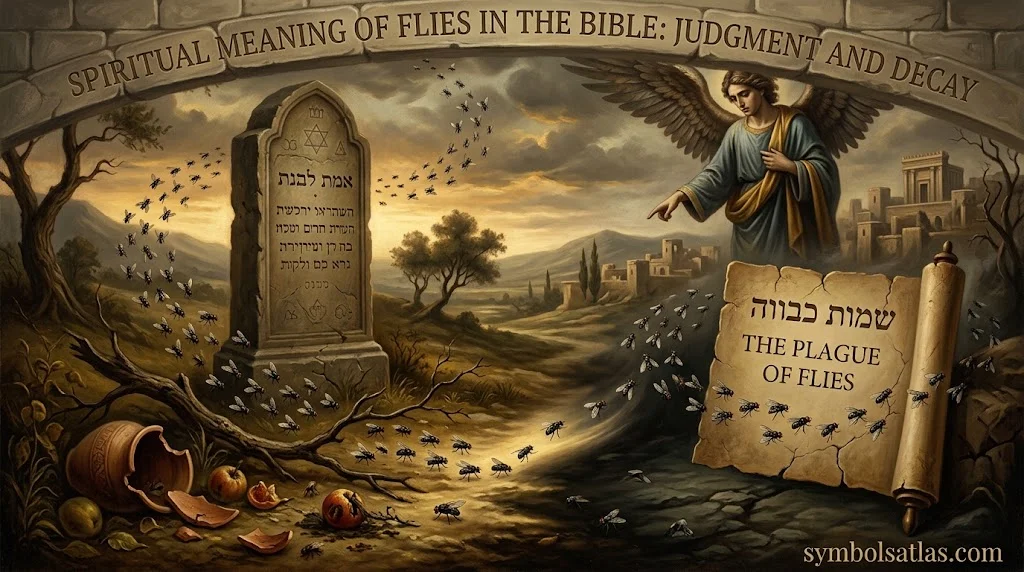

Flies may seem like ordinary insects, but the spiritual meaning of flies in the Bible can carry deeper lessons about corruption, impurity, decay, temptation, and spiritual warning.
Throughout Scripture, flies appear in meaningful contexts that connect them with uncleanness, destruction, and negative influences. One well-known example is Beelzebub, a name associated with “lord of the flies,” while other biblical passages use flies to illustrate how something small can create serious trouble. Understanding these references can help you explore the biblical symbolism of flies without assuming that every encounter with a fly is a supernatural sign. Instead, these passages encourage reflection on sin, spiritual discernment, consequences, and personal growth. They can also remind believers to stay spiritually alert and protect their hearts from influences that slowly lead them away from what is good.
The spiritual meaning of flies in the Bible is therefore best understood through biblical context rather than superstition. Flies can represent the unpleasant effects of decay, disorder, corruption, and harmful influences, offering lessons about how seemingly small problems can become significant when ignored. From the story of Ecclesiastes to the judgment described through the plague of flies in Exodus, these references provide different perspectives on impurity, consequences, and divine intervention. Exploring these passages can reveal how biblical writers used everyday creatures to communicate powerful spiritual ideas. Whether you are studying Scripture, seeking Christian symbolism, or wondering about a fly-related spiritual experience, the Bible offers a thoughtful foundation for understanding its possible meaning.
Quick Answer
The spiritual meaning of flies in the Bible is often associated with judgment, decay, corruption, and spiritual warning, especially in passages involving plagues or spoiled things. In a broader spiritual reading, flies may remind a person to notice what is becoming unhealthy or neglected in life.
TL;DR
- Flies often symbolize decay, corruption, judgment, and warning.
- Exodus connects swarms of flies with divine judgment against Egypt.
- Ecclesiastes uses dead flies to picture corruption ruining something valuable.
- In America, flies commonly evoke cleanliness, death, waste, and decay.
- Not every fly encounter carries a biblical supernatural message.
- Biblical symbolism depends strongly on context and interpretation.
What Do Flies Represent in the Bible?
Flies have an unpleasant but meaningful place in biblical imagery. Their connection with waste, death, and spoiled matter made them natural symbols of things that destroy or corrupt.
Decay and Corruption
One of the clearest examples appears in Ecclesiastes 10:1. The passage describes dead flies spoiling a perfumer’s ointment.
The image is simple but powerful. Something valuable can be damaged by something small that is allowed to remain.
This creates a spiritual lesson about small problems becoming serious problems. A harmful habit, careless decision, or moral weakness can gradually affect something otherwise good.
Judgment and Consequences
Flies also appear in the story of the Egyptian plagues. In Exodus 8, swarms of flies become part of the judgments against Egypt.
Here, flies aren’t simply household pests. They become part of a larger story involving divine power, oppression, deliverance, and consequences.
For many readers, this makes flies an image of warning and accountability rather than merely an image of dirt.
A Symbol of Disorder
Flies also thrive around conditions people consider unsanitary or decaying. As a result, they can symbolize environments where something has been neglected.
This interpretation can apply spiritually to areas of life that need attention, honesty, or renewal.
Historical Background of Flies in Biblical Times
Understanding ancient life makes biblical fly imagery easier to understand. People living thousands of years ago experienced insects, disease, food spoilage, animals, and decomposition without modern sanitation.
Flies in the Ancient Near East
Flies were common around food, livestock, waste, and decomposing material. They could quickly become a major nuisance.
Because of this, people naturally associated them with unclean conditions and decay. Biblical writers could use familiar experiences to communicate deeper spiritual ideas.
The symbolism wasn’t necessarily mysterious to ancient audiences. A swarm of flies was an immediate image of discomfort, disorder, and contamination.
Ancient Egypt and the Fly
Interestingly, flies weren’t always viewed negatively across the ancient world. In ancient Egypt, fly-shaped objects and amulets could have protective or honor-related associations.
Some fly amulets have been connected with military courage and distinction. This reminds us that symbolism changes between cultures.
Therefore, the biblical meaning of flies shouldn’t automatically be applied to every ancient culture.
Why Biblical Writers Used Natural Images
Biblical literature frequently uses ordinary parts of nature to communicate moral or spiritual ideas. Animals, plants, weather, insects, and landscapes could all become illustrations.
Flies worked particularly well because people already understood their connection with decay and disturbance.
Flies and Judgment in Exodus
The story of the flies in Exodus is one of the strongest biblical connections between flies and judgment. The event forms part of the series of plagues brought upon Egypt.
The Plague of Flies
In Exodus 8, Moses warns Pharaoh about a coming swarm. The flies become a sign of escalating conflict between Pharaoh’s refusal and God’s demand for Israel’s release.
The passage also emphasizes a distinction between the Egyptians and the Israelites in the biblical narrative.
That detail makes the flies part of a larger story about judgment, protection, power, and deliverance.
What the Plague Can Symbolize Today
Modern readers may interpret this passage as a reminder that actions have consequences. However, the original story should not be reduced to a simple formula about every fly someone sees.
A fly in your kitchen isn’t automatically evidence of divine judgment. The biblical passage describes a specific event within a specific historical and theological narrative.
Key Themes in Exodus
The fly plague can be connected with several broader ideas:
- Judgment following persistent wrongdoing
- Consequences that become impossible to ignore
- Deliverance from oppression and suffering
- Divine authority over creation
- Warning before consequences become greater
What Does a Fly Mean in Ecclesiastes?
Ecclesiastes provides one of the most memorable uses of fly imagery in Scripture. Ecclesiastes 10:1 says that dead flies can cause a perfumer’s ointment to give off a bad smell.
Small Things Can Spoil Something Valuable
Perfume represented something valuable and carefully prepared. Yet a small dead insect could ruin its pleasant character.
The lesson is about the destructive power of seemingly minor problems.
This makes the fly a useful symbol for small compromises, foolish behavior, and neglected problems.
A Lesson About Character
The passage can also encourage self-examination. Someone may have many good qualities while still allowing one harmful behavior to affect their reputation.
In this sense, the fly represents something small that becomes significant because it is ignored.
For a modern American reader, the comparison is easy to understand. One careless comment can damage years of trust, just as one contaminant can spoil something valuable.
Flies and Beelzebul in the New Testament
The New Testament introduces another important association involving flies. In several passages, Jesus’ opponents accuse him of driving out demons by the power of Beelzebul.
The Meaning of Beelzebul
Beelzebul is traditionally connected with the expression “lord of the flies,” although the history of the name is complex.
The term is related to older Semitic names and traditions, and its exact linguistic development has been debated by scholars.
In the New Testament, however, the name functions as a hostile title associated with demonic power.
Why This Matters
This connection contributed to the later Christian association between flies and evil, corruption, temptation, and spiritual opposition.
However, it shouldn’t be treated as though every biblical reference to flies means demons.
The contexts are different, and careful interpretation matters.
What Do Flies Symbolize Spiritually?
Outside direct biblical passages, people often give flies broader spiritual meanings. These interpretations are more devotional or symbolic than explicit biblical teachings.
Common Spiritual Interpretations
A fly may be interpreted as a reminder to examine an area of life that feels neglected.
Common interpretations include:
- Spiritual warning about something requiring attention
- Decay in a relationship, habit, or personal situation
- Corruption that begins with small compromises
- Distraction from important spiritual priorities
- Transformation through recognizing what needs to change
- Awareness of problems that have been overlooked
These meanings should be treated as interpretations, not guaranteed messages from God.
A Useful Question to Ask
If flies repeatedly appear around you, consider the practical explanation first. Food, garbage, drains, pets, weather, and nearby organic material can all attract flies.
After addressing the physical cause, personal reflection can still be meaningful if it helps you think about your values or choices.
Spiritual Meaning of Flies in America Today
In the United States, flies generally have strong everyday associations with waste, sanitation, spoiled food, and decomposition.
American culture also frequently connects flies with death or unpleasant environments through movies, literature, horror imagery, and popular media.
Everyday American Associations
| Context | Meaning in the USA | Common Associations | Notes |
| Home | Neglect or sanitation concern | Garbage, food, drains | Usually has a practical cause |
| Death imagery | Decay and mortality | Bodies, decomposition | Common in horror and literature |
| Biblical study | Judgment or corruption | Exodus, Ecclesiastes | Meaning depends on passage |
| Personal reflection | Warning or neglected issue | Habits, relationships | Symbolic rather than literal |
| Pop culture | Disgust or transformation | Horror, insects, decay | Often more dramatic than biblical usage |
Why the Symbol Feels So Strong
American culture tends to place a high value on cleanliness and hygiene. Because flies are commonly associated with contamination, their symbolic impact can feel immediate.
Therefore, seeing a fly can trigger feelings of disgust before a person consciously considers its symbolic meaning.
What Do Flies Mean Emotionally and Psychologically?
Flies can produce strong emotional reactions because they are persistent, difficult to ignore, and often associated with unpleasant environments.
Disgust and Irritation
The buzzing sound and unpredictable movement of flies can create irritation. Their association with waste can also produce disgust.
Symbolically, these emotions may represent something a person wants to remove from their life.
Intrusive Thoughts and Distractions
A fly repeatedly landing on a person can feel distracting. In symbolic reflection, this can represent an unwanted thought or recurring problem.
The important point is that this is a metaphor, not a psychological diagnosis.
Mortality and Impermanence
Because flies are often seen around decomposition, they can also remind people of mortality.
For some people, that association encourages reflection on time, priorities, relationships, and what truly matters.
What Does It Mean to Dream About Flies?
Dream interpretations involving flies vary widely. The Bible doesn’t provide a universal rule saying that dreaming about a fly always has one meaning.
Common Symbolic Interpretations
Modern spiritual dream interpretation may associate flies with:
- Something irritating that won’t go away
- A situation that feels contaminated or unhealthy
- Anxiety about decay or loss
- A small problem becoming more serious
- A need to clean up an emotional situation
- Awareness of something previously overlooked
The personal context of the dream matters more than a fixed dictionary definition.
Biblical Caution About Dreams
The Bible contains dreams with important meanings, but it doesn’t teach that every dream carries a divine message.
Therefore, a fly appearing in a dream shouldn’t automatically be treated as a prophecy or warning from God.
What Does It Mean When Flies Keep Appearing?
Repeated flies can feel meaningful, especially when they appear during an emotionally difficult period. Still, practical causes should be considered before assigning spiritual significance.
Start With the Physical Explanation
Check common sources such as food waste, standing water, drains, pet areas, compost, and damaged screens.
Seasonal weather can also increase fly activity.
Then Consider Personal Reflection
If the practical explanation doesn’t fully satisfy your curiosity, you can use the experience as a reflective prompt.
Ask yourself whether anything in your life feels neglected, unhealthy, distracting, or overdue for change.
This approach respects both ordinary causes and personal spirituality without claiming certainty.
Flies in Cross-Cultural and Spiritual Traditions
Fly symbolism isn’t limited to Christianity or the Bible. Different cultures have assigned different meanings to flies and related insects.
Ancient Traditions
Some ancient traditions associated flies with disease, death, decay, or unwanted forces. Others gave fly imagery more positive meanings.
As noted earlier, ancient Egyptian fly amulets show that the insect could sometimes represent strength or distinction.
Jewish and Christian Contexts
Within biblical traditions, flies appear in narratives involving judgment and corruption. The exact meaning changes according to the passage.
Christian interpretations later expanded some fly imagery through discussions of Beelzebul and demonic symbolism.
A Broader Lesson
Cross-cultural symbolism shows why it is risky to claim that flies have one universal spiritual meaning.
Symbols develop through language, religion, environment, history, and human experience.
Read More: Spiritual Meaning of Hitting a Bird With Your Car
Modern Uses of Fly Symbolism
Today, fly imagery appears in art, tattoos, fashion, literature, entertainment, and online discussions.
Its meaning can range from disturbing to thoughtful.
Tattoos and Personal Symbolism
A fly tattoo might represent mortality, resilience, transformation, disgust, rebellion, or fascination with nature.
For someone drawing specifically from biblical imagery, it might instead represent warning, corruption, judgment, or the consequences of neglect.
Art and Home Decor
Artists sometimes use insects to explore uncomfortable themes. Fly imagery can make viewers think about death, impermanence, environmental change, or human behavior.
However, modern artistic symbolism isn’t necessarily biblical symbolism.
Social Media
Online spiritual content sometimes presents repeated animal or insect encounters as direct messages.
These interpretations can be meaningful as personal reflections. However, they shouldn’t be confused with explicit biblical teachings.
Misunderstandings and Controversies About Fly Symbolism
Fly symbolism can easily become exaggerated. One common misunderstanding is treating every fly as a supernatural warning.
Not Every Fly Is a Spiritual Sign
The Bible does not say that every ordinary fly carries a message for the person who sees it.
A fly may simply be attracted to food, moisture, waste, or warmth.
Symbolism Is Not a Prediction
Biblical symbolism can communicate themes without predicting a person’s future.
Therefore, seeing flies shouldn’t automatically lead someone to expect tragedy, punishment, or spiritual attack.
Avoiding Fear-Based Interpretations
Fear can make ordinary events feel more significant than they are.
A balanced interpretation asks what the biblical passage actually says while allowing personal reflection to remain personal.
How the Meaning of Flies Has Changed Over Time
Fly symbolism has never been completely fixed. Its meaning has shifted as cultures, languages, religions, and social conditions changed.
From Physical Nuisance to Spiritual Symbol
In the ancient world, people experienced flies as real pests connected with food, animals, waste, and decomposition.
Biblical writers could therefore use them as vivid images of corruption and judgment.
Medieval and Later Christian Interpretations
Later Christian traditions sometimes connected flies more strongly with demons, temptation, and evil because of associations involving Beelzebul.
These interpretations influenced European art and literature.
Modern Interpretations
Today, many Americans encounter fly symbolism through movies, books, tattoos, artwork, and social media.
Modern interpretations often emphasize decay, mortality, transformation, contamination, or personal warning.
The biblical foundations remain important, but contemporary meanings can be broader.
How to Reflect on the Biblical Meaning of Flies
If flies have caught your attention during a meaningful period, reflection can be more useful than fear.
Consider the Context
Think about what was happening when you noticed them. Were you dealing with a neglected responsibility, difficult relationship, major transition, or moral decision?
The goal isn’t to assume a supernatural cause. Instead, the experience can become an opportunity for honest reflection.
Look for the Biblical Theme
The strongest biblical themes include judgment, corruption, consequences, and the danger of allowing something small to spoil something valuable.
Those themes can encourage practical self-examination.
Focus on Renewal
Symbolism becomes most useful when it leads to constructive action.
Rather than asking only, “Is this a bad sign?” consider asking, “Is there something in my life that needs attention?”
That question turns an uncomfortable image into an opportunity for growth.
FAQs
1. What is the spiritual meaning of flies in the Bible?
The spiritual meaning of flies in the Bible is often connected with corruption, impurity, decay, trouble, and negative influences. Biblical references to flies can serve as warnings about the consequences of sin and the importance of spiritual awareness.
2. What do flies symbolize in Christianity?
In Christian symbolism, flies can represent uncleanness, corruption, temptation, and spiritual disturbance. Their presence in biblical stories sometimes illustrates how something seemingly small can create significant problems.
3. Does seeing a fly mean something spiritually?
Seeing a fly does not automatically mean that God is sending a specific supernatural message. From a biblical perspective, it is better to consider the circumstances and reflect on relevant Scripture rather than treating every ordinary event as a spiritual sign.
4. What does Ecclesiastes 10:1 say about flies?
Ecclesiastes 10:1 uses dead flies to illustrate how a small amount of corruption can spoil something valuable. The verse provides a powerful lesson about wisdom, reputation, character, and the consequences of seemingly minor mistakes.
5. What does Beelzebub mean in the Bible?
Beelzebub is a name associated with the “lord of the flies” and is used in the New Testament in connection with Satan. The term contributes to the broader biblical association between flies and evil or spiritual corruption, although its historical meaning and development are more complex.
Conclusion
The spiritual meaning of flies in the Bible offers valuable lessons about corruption, impurity, temptation, consequences, and spiritual vigilance. Biblical references do not necessarily suggest that every fly carries a personal supernatural message. Instead, they use familiar imagery to communicate deeper truths about human behavior and the effects of allowing small problems to grow.
When you encounter flies or study their biblical symbolism, let the experience encourage self-reflection and spiritual discernment rather than fear. Scripture repeatedly points believers toward wisdom, repentance, faith, and a closer relationship with God. Ultimately, the symbolism of flies can remind us that protecting our character, thoughts, and spiritual life requires attention even to problems that initially seem small.